Showing posts with label evolution. Show all posts

Wednesday, June 18, 2014

Only Some of These Really Bother Me

(A version of this post has also appeared on my Tumblr)
Article header from io9.com: "10 Scientific Ideas That Scientists Wish You Would Stop Misusing"
There's an article on io9.com listing ten words/concepts from various fields of science that are commonly misused by laypeople, so I had to look at it and see if any of my pet peeves made it onto the list.

There were a few:
3. Quantum Uncertainty and Quantum Weirdness
[Astrophysicist Dave] Goldberg adds that there's another idea that's been misinterpreted even more perniciously than "theory." It's when people appropriate concepts from physics for new agey or spiritual purposes:
This misconception is an exploitation of quantum mechanics by a certain breed spiritualists and self-helpers, and epitomized by the abomination, [the movie] What the Bleep Do We Know? Quantum mechanics, famously, has measurement at its core. An observer measuring position or momentum or energy causes the "wavefunction to collapse," non-deterministically. (Indeed, I did one of my first columns on "How smart do you need to collapse a wavefunction?") But just because the universe isn't deterministic doesn't mean that you are the one controlling it. It is remarkable (and frankly, alarming) the degree to which quantum uncertainty and quantum weirdness get inextricably bound up in certain circles with the idea of a soul, or humans controlling the universe, or some other pseudoscience. In the end, we are made of quantum particles (protons, neutrons, electrons) and are part of the quantum universe. That is cool, of course, but only in the sense that all of physics is cool. 
4. Learned vs. Innate
Evolutionary biologist Marlene Zuk says:
One of my favorite [misuses] is the idea of behavior being "learned vs. innate" or any of the other nature-nurture versions of this. The first question I often get when I talk about a behavior is whether it's "genetic" or not, which is a misunderstanding because ALL traits, all the time, are the result of input from the genes and input from the environment. Only a difference between traits, and not the trait itself, can be genetic or learned — like if you have identical twins reared in different environments and they do something different (like speak different languages), then that difference is learned. But speaking French or Italian or whatever isn't totally learned in and of itself, because obviously one has to have a certain genetic background to be able to speak at all.
....
6. Gene

[Synthetic biologist Terry] Johnson has an even bigger concern with how the word gene gets used, however: 
It took 25 scientists two contentious days to come up with: "a locatable region of genomic sequence, corresponding to a unit of inheritance, which is associated with regulatory regions, transcribed regions and/or other functional sequence regions." Meaning that a gene is a discrete bit of DNA that we can point to and say, "that makes something, or regulates the making of something". The definition has a lot of wiggle room by design; it wasn't long ago that we thought that most of our DNA didn't do anything at all. We called it "junk DNA", but we're discovering that much of that junk has purposes that weren't immediately obvious. 
Typically "gene" is misused most when followed by "for". There's two problems with this. We all have genes for hemoglobin, but we don't all have sickle cell anemia. Different people have different versions of the hemoglobin gene, called alleles. There are hemoglobin alleles which are associated with sickle cell diseases, and others that aren't. So, a gene refers to a family of alleles, and only a few members of that family, if any, are associated with diseases or disorders. The gene isn't bad - trust me, you won't live long without hemoglobin - though the particular version of hemoglobin that you have could be problematic. 
I worry most about the popularization of the idea that when a genetic variation is correlated with something, it is the "gene for" that something. The language suggests that "this gene causes heart disease", when the reality is usually, "people that have this allele seem to have a slightly higher incidence of heart disease, but we don't know why, and maybe there are compensating advantages to this allele that we didn't notice because we weren't looking for them".
Those were the ones that resonated with me the most; others were only minor peeves or didn't actually bother me at all.

Misused Word #1, "Proof," was only a minor annoyance for me in that I'm almost never talking about mathematical proofs, and even if I were the sort of person who does use them routinely, it still seems to me like most things people talking about "proving" colloquially are impossible to express in mathematical terms.

It just seems to me like there wouldn't be very many circumstances in which mixing up the technical and colloquial meanings of "proof" would be an issue that would even arise.

(I have found that the most annoying sources of confusion in scientist/layperson conversations about proof have to do with standards of evidence, or also degrees of uncertainty. You can be more unsure of one thing than you are of another, even if you're not 100% certain about the thing you are more sure of.)

Similarly, "theory" also doesn't annoy me that much because I don't usually have much trouble adjusting to different usages of words in different contexts.

I can see how it would get really old having to explain the technical meaning of "theory" over and over again, though.
It seems like those are more about the meaning of specific words than they are about whole networks of ideas, so they are easier for me to adapt to when they surprise me in conversation.
The ones discussed in the quoted text above, though? Misuse of ideas derived from quantum mechanics, misinterpretations of evolution and natural selection, or the idea that genes are "for" specific things? Those come with so many other ideas connected to them, so many wrong things tacitly accepted as premises, that I feel like I need a ball of yarn to slowly pick my way back to the start of the conceptual maze.

Thursday, June 14, 2012

Two Quick Links about Why the Fight over Evolution Matters

So, apparently Kevin Drum, a political commentator I don't read but who is apparently somewhat well-known, has written an article for Mother Jones declaring the fight over how whether biology is taught in public schools an irrelevant sideshow. 


I was nonplussed by this. Obviously, it's not the most important issue in the world --- it doesn't pose an existential threat the way climate change, peak oil/peak everything, overpopulation and hunger do, and it doesn't have the dire social consequences (or moral urgency) of, say, restricting access to contraception, the mass incarceration of people of color and poor people, increasing economic inequality or the deliberate demolition of the welfare state --- but I still felt like it had some importance that went beyond mere cultural border-policing*.


Amanda Marcotte at Pandagon and PZ Myers at Pharyngula both responded to Drum's article, and each of them made points that rang true for me, and helped explain why his statement bothered me.


Amanda:
I have to admit, I'm boggled at Kevin Drum's reaction to the news that nearly half of Americans are young Earth creationists ... . He completely misreads the situation and frankly does so in a way that I personally felt thrown under the bus.
... 
Kevin takes it as a given that fights over what's taught in high school are strictly about symbolism and have no real importance. I suspect that's a much easier view to take if you're the beneficiary of a good public school in a blue area or lucky enough to have gone through or been able to put your own kids through private school. For someone who went to a rural high school in Texas, the notion that high school doesn't matter strikes me as ridiculous in the extreme. 
The reason conservatives target high schools (and junior high schools and elementary schools) isn't because they're playing for peanuts. On the contrary, conservatives understand something liberals don't, which is that if you get people while they're young, you usually have them for life. This is also, incidentally, why conservatives pay more attention to pop culture than liberals. Liberals are great people --- I'm one of them! --- but  we have a tendency towards preening individualism and therefore discount the importance of things like what's in the classroom and what's on TV because we personally feel we're iconoclasts who aren't affected by it. Which can, in this case, cause us to neglect to remember that in fact this is the air that most people breathe, and the quality of that air matters. 
I also had strong feelings of no you're wrong when I read the paragraph in Drum's article where he dismisses "a 10th grade understanding of evolution" as something so piddling as to be dispensed with entirely, so much does it pale in comparison to the understanding of evolution one gets (presumably) in college, or in books on evolutionary biology. PZ, along with a slew of other biology professors in his comments and at Mother Jones, takes him to task for this; they write that, no, actually, they have noticed a change in how readily their students grasp what they have to teach. Almost as if high school curricula were geared toward preparing the students for college ... 


Anyway, what felt unfair to me was his assumption that, if people needed the knowledge, they could always pick it up elsewhere. This made me angry, because for many people there is no "elsewhere," or at least not one that is immediately accessible without guidance. 


(Who has tried to teach themselves a completely novel subject by checking out books on it from the library? Isn't it hard to figure out which books will be the ones you need? Technical books are often overly specific and assume you've already got a grounding in the subject, and are interested in exploring a particular question within it, and books for laypeople might not be thorough enough, and also might not be trustworthy). 


As for college, well, not everyone goes there, most of the people who go there will never encounter evolution in the classroom --- I didn't, and I majored in a biological science! --- and, again, college professors have enough to do without having to burn up lecture time with remedial material and correcting misinformation. Plus, not all colleges are created equal; some 


To top it off, what you know before college helps determine where you go, whether you go at all, and what you study! College is expensive, and for many prospective students (I know I felt this way when I was applying to colleges) the size of the scholarship you can get makes the decision for you. Scholarships for merit, as opposed to need (and there will always be more people who can't really afford college than there are people officially deemed too poor to afford college on their own), depend on how one performs on standardized tests. And what does standardized test performance depend on? What you learned in high school.


There's more: as Amanda also points out, what you're exposed to in high school shapes your interests and aspirations:
[M]y high school biology course didn't teach evolution. Without evolution, biology actually doesn't make sense, and instead it's just an anatomy class. ... I had no idea how fascinating biology actually was until I was an adult, and long past any chance of starting on that as a career path. Not that I think I would, but you can easily see someone like me making that choice as a young woman, but not really being able to because I was never offered that option in a realistic sense to begin with. 
(As someone who did study biology, and who loves Amanda's writing about science- and skepticism-related topics as much as I do her feminist writing, I can see it. Her interest in the subject is obvious, as is her commitment to find out what's true and how we know it's true. While she won't --- can't --- go into the kind of technical details I sometimes do here, her grasp of general, foundational principles is firm enough that I can easily forget she does not possess a biology degree herself.)


To shift to another aspect of why Drum's assessment is so horribly, horribly wrong, I quote PZ:
[T]his is going to be the century of dependence on the sciences. Climate change is going to hit us all; environmental crises are going to rise up all over the place; we're going to face shortages of energy and fresh water; emerging diseases will be a major concern; new biomedical technologies will cause cultural shocks; the whole world is going to change. Most people, I agree, will not be doing the research that leads to changes, and most of these problems will require political and social changes to correct, but how are you going to convince people to, for instance, change their fuel consumption habits when they're in complete denial of basic facts? How can you expect people to appreciate the importance of ecology and global interactions when you tell them that evolution doesn't matter? How will you get them to make rational decisions to control pandemics when they can't comprehend probability, epidemiology, and viral/bacterial evolution on even the most basic level? 
Most importantly, though, this utilitarian attitude that all that matters is what people can directly use in their day-to-day life is a denial of the Enlightenment and principles on which our country was founded. It's a rejection of the liberal idea that human beings should be well-rounded and informed individuals --- the informed citizenry that should be the foundation of a democracy. We can't expect everyone to be biologists or poets or political scientists, but we should expect that one outcome of a public education is an appreciation of the breadth of human endeavor, and at least a smattering of the fundamentals of a wide range of subjects, sufficient that, to make it practical again, students can make informed career decisions and understand a basic argument from evidence from an expert. We lack that now. And to wave away a simple but essential starting fact about our existence as unimportant is deeply offensive.     
I would add to his first paragraph that you don't have to wait for some futuristic nightmare scenario for these things to affect people's lives. Disease-causing bacteria are already becoming resistant to a whole lot of the antibiotics we use to fight them; lots and lots of species have disappeared or are disappearing; sensitive ecosystems are already being stressed, some to the breaking point by human activity, and humans are already failing to see why they should care***.

The picture he paints in that first paragraph has already come to pass, in the way that the proverbial camel is already in the tent, he just needs to take a few steps forward before it becomes obvious to everyone.

I would also add something else that I think denying evolution does: it makes it easier to think of humans as separate from, and above, the natural world and all those other animals. It allows us to think that what we do to it, to them, will never get back to us. 

(You don't have to deny evolution to get to that mindset, though: I see it arising just as readily from the erroneous view of evolution as a teleological process of development from simple to complex organisms, with humans sitting triumphantly at the apex. I've posted before about my annoyance with this picture of evolution.)

*This is what Andrew Sullivan, another famous political commentator whom I know to be obtuse, thanks to driftglass, an obscure political blogger who is quite acute**, has called belief in creationism a "cultural signifier" that describes the group membership of the believer rather than what that person actually believes about reality. That whole line of reasoning makes me queasy, but even if he is right that no one actually believes the Earth is six thousand years old and every animal species living on it was molded from clay and animated with the breath of a god, if that is what they decide shall be taught to children as fact, in place of the full history of life on Earth (as much of it as we know, anyway) and an explanation of how life on Earth has changed as Earth itself has changed, then those children grow up with a much poorer understanding of the world around them. An idea can have consequences in the real world whether people truly believe it or not; all they need to is act as if they believe it. Also, Andrew Sullivan is dumb.

**Hee. I made a geometry pun.

***This is not, at all, meant to be an exhaustive list, or even a primer on any of those subjects. I just put a recent news/research story in every link to make the point that, yes, this stuff is happening, and it's not just one or two isolated incidents. 

Thursday, May 5, 2011

Memento Mori: Thoughts of Mortality Can Subtly Bias People's Ideas about Human Origins

Death, be not proud, though some have callèd thee
Mighty and dreadful, for thou art not so;
For those, whom thou think'st thou dost overthrow,
Die not, poor Death, nor yet canst thou kill me.

-- John Donne, from Holy Sonnet X (also called "Death, Be Not Proud")


ResearchBlogging.orgBPS Research Digest described a recent study in which a group of psychologists looked at the influence of thoughts of one's own death on people's attitudes toward two different ideas about human origins: evolutionary theory and the variant of creationism known as Intelligent Design.
The researchers --- Dr. Jessica L. Tracy, who is an assistant professor of social and personality psychology at the University of British Columbia's Vancouver campus, where she is also director of the Emotion and Self Lab, Dr. Joshua J. Hart, who is an assistant professor of psychology at a small liberal arts college in New York called Union College, and UBC graduate student Jason Martens --- went to rather more trouble than is usual in these social-psychology studies in their search for a diverse study population.


Too often, these studies make claims about "people" based on surveys of psychology undergraduates at one university. In this study, one of the five mini-experiments involved people from all over the US who filled out surveys online. They ranged in age from 18 to 75, with a median age of 37, so most of them were substantially older than the college students questioned in the other four experiments. They also came from (one assumes) a broader distribution of socioeconomic classes; socioeconomic data are not given for any of the student groups, but the general-population group includes people from a wide range of income levels: 12% of respondents reported making less than $20,000 a year, 25% made between $20,000 and $40,000, 20% made between $40,000 and $60,000, 11% made between $60,000 and $80,000, 8% made between $80,000 and $100,000, and 9% made more than $100,000 a year. (Fifteen percent of respondents chose not to say how much money they made). The general-population sample also included people with more widely varying educational backgrounds: 26% had a high school diploma or less, 33% had been to college but hadn't gotten a degree, 32% had a college degree, and 9% had a postgraduate degree.


The other four groups consisted entirely of college students; two of the groups were all psychology students recruited from either UBC or Union College, one group was college students recruited online from all over the U.S. and Canada, and the last group was natural-science students* from UBC and Union College.
Each group of participants was asked to specify their religion and rate how religious they thought they were, and then to read a passage written by either Richard Dawkins or Michael Behe discussing either evolution or Intelligent Design, and rate their attitudes toward the two belief systems and their representative authors.


Right before they did this, they were asked to imagine one of two unpleasant things (death vs. painful dental work) and write briefly about their feelings. The reason for including this morbid exercise was to see if bringing mortality to the forefront of people's minds had any effect on their preference for a naturalistic or deistic worldview.
They found that, for most people, being reminded of death does tend to make you more receptive to Intelligent Design and more hostile to evolution. This is true regardless of one's educational attainment, religion or religiosity. It was also true regardless of one's attitude toward evolution as measured before the experiment.
(Some more explanation of that last sentence: yes, being more religious meant you were more likely to be receptive to Intelligent Design whether you were asked to contemplate death or not; likewise with being Christian rather than belonging to any other religious tradition, or claiming no religion. But within each category, the researchers saw the same effect of the memento mori nudging people toward Intelligent Design and away from evolutionary theory. Oddly, being reminded of death did not prompt people to rate themselves as more religious, even though it had a noticeable effect on their ideas about human origins.)


While how much education a person had didn't make any difference in how they responded to the memento mori, the type of education did have some dampening effects. Compared to the general-population and general-student-population groups, the psychology students expressed less hostility to evolutionary theory in response to the memento mori, although they showed the same increase in receptivity to Intelligent Design.


Resistance to these effects was strongest in the natural-science students, who actually responded in the opposite way to the memento mori; when confronted with the thought of death, they reported feeling a stronger affirmation of evolution and repudiation of creationism.


The authors hypothesized that people would react to the thought of death by looking for something that confers some lasting meaning on human life; for most people, a divine Creator fills that role readily enough. One of their experiments --- one of the two using psychology undergraduates as guinea pigs --- addressed this hypothesis directly: they compared the responses of students who had read a passage by Carl Sagan aimed at dispelling fears that the scientific understanding of the universe is nihilistic with those of students who did not read this humanistic passage, looking to see if exposure to a Middle Way between deism and nihilism didn't moderate the shift toward Intelligent Design prompted by the students' meditating on their own deaths.


Here is the Sagan passage:


It is very reasonable for humans to want to understand something of our context in a broader universe, awesome and vast. It is also reasonable for us to want to understand something about ourselves. And understanding the nature of the world and the nature of ourselves is, to a very major degree, I believe, what the human enterprise is about. Truth should be pursued, and science helps us pursue it; science gives us meaning. All we have to do is maintain some tolerance for ambiguity, because right now science does not have all the answers. This tolerance goes with the courageous intent to greet the universe as it really is, not to foist our emotional predispositions on it but to courageously accept what our explorations and knowledge tell us. The more likely we are to assume that the solution comes from something outside science, the less likely we are to solve our problems ourselves. If we are merely matter that is intricately assembled, is this really demeaning? If there's nothing in here but atoms, does that make us less, or does that make matter more? We make our purpose. And we have to work out what that is, for ourselves.


Ahhh. Humanism. (Go on, bask in it!)


Sure enough, students who read this passage did seem to be less threatened by evolution, even with thoughts of their own individual mortality foremost in their minds: they responded to the thought of death by reporting less of a warm feeling for Intelligent Design, and more for evolutionary theory.


Here is the authors' summation of their findings:


The present findings demonstrate that reminders of one's mortality --- inducing a state of mortality salience --- promote relative support for [Intelligent Design Theory], and skepticism toward [Evolutionary Theory]. Individuals respond to existential threat by becoming more accepting of a theory that offers a greater sense of meaning by depicting human life as having ultimate purpose (while appearing consistent with the scientific worldview), and/or less supportive of the theory that is the true mainstay of the scientific worldview but seems to offer little in the way of existential comfort. These findings also suggest that a desire to find greater meaning in human life accounts for this effect (at least the effect of mortality salience on belief in IDT), because it is reversed by making ET more meaningful, and among natural-science students for whom ET is already meaningful. The findings are notable because they (a) help explain why some people are motivated to believe in IDT and doubt ET in terms of fundamental psychological drives; (b) account for the underlying causal process; and (c) emerged regardless of preexisting religious ideologies, religious affiliation, or (with one highly limited exception, discussed below) views of evolution. The last point suggests that although religion influences baseline beliefs in IDT and ET, it cannot account for the impact of MS on these views. Given previous research suggesting that many MS effects are heightened, or occur only, among individuals with certain preexisting belief systems or cultural associations, the fact that we found no moderators of MS effects --- other than the extent to which naturalism is seen as meaningful --- suggests that embracing IDT or rejecting ET may be a unique, broadly appealing mechanism that addresses the existential concerns of religious and, for the most part, more scientifically oriented individuals alike. In contrast, explicitly religious ideologies tend to be fairly parochial, limiting their appeals and making them viable defenses only for those who already believe in a supernatural god.

Yet, an exception emerged in Study 5, where individuals whose life goals require strong acceptance of ET showed the opposite responses. Like those explicitly taught, in Study 4, to view naturalism as a source of meaning, natural-science students responded to MS with stronger antagonism toward IDT. This provides converging support for the causal process found in Study 4, and suggests that rejecting IDT can be a source of existential comfort for a limited population of individuals. These individuals are not simply those steeped in the scientific cultural worldview --- presumably psychology undergraduates fall into that category --- but rather those who more specifically view evolution as a critical part of their understanding of the world and a source of meaning and purpose.
They also point out in the final section of the article that these results might shed some light on why creation-vs.-evolution has remained such an intractable social issue: rather than being solely determined by religious doctrine, political ideology or (lack of) scientific literacy, people's embrace of creationism is also a response to the fear of death. Merely cataloguing the evidence for evolution doesn't address these underlying emotional issues; it tears away the defense mechanism while providing nothing to replace it. To my mind, that goes a long way toward explaining not only the deadlock between sides but also the rancor in this debate.

(Of course, many evolution-defending speakers do emphasize the existential perks of their worldview: a sense of wonder at being part of such a beautiful, intricate, ever-changing universe; the feeling of joy as you discover deeper and deeper layers of life's complexity; a stronger sense of kinship with other forms of animal life, etc. Why, even Richard Dawkins, the theorist featured in this study as representative of the godless, naturalistic worldview, has written a lot --- most notably in his book Unweaving the Rainbow --- about the beauties and benefits of that worldview. So the emotional angle isn't all there is to this, though I think it is important and not usually given the prominence it deserves).


*The authors do not explain what fields are included in this umbrella category "natural sciences." As it is commonly used, it encompasses fields having nothing whatsoever to do with evolution, like physics, or chemistry, or astronomy or geology. So I would quibble a bit with their assertion that strong acceptance of evolutionary theory is necessary for one to progress in the "natural sciences" --- it is quite possible to complete a degree in a non-biological science field without ever encountering it.


Tracy, J., Hart, J., & Martens, J. (2011). Death and Science: The Existential Underpinnings of Belief in Intelligent Design and Discomfort with Evolution PLoS ONE, 6 (3) DOI: 10.1371/journal.pone.0017349

Tuesday, September 15, 2009

"The Next Step in Evolution"

(Cross-posted to Turner & Kowalski)

Over at John Elder Robison's blog, there's a two-part guest post on what it's like to be a woman with Asperger's. The guest blogger's name is Deborah McCarthy, and she is 49 years old, a vegan, an animal-rights activist, a Christian, and lives in Oregon.

While most of her writing just deals with her own experiences, particularly the differences she's identified between the way she thinks, feels, and perceives the world and the way most people do (and therefore often expect her to be that way, too), there are a couple of instances where she decides to make general pronouncements about things she really doesn't understand all that well. The statements she makes are inflammatory, hurtful (one more than the other, but neither is totally innocuous) and scientifically illiterate on a grand scale.

First, there's this:
Everybody says Asperger's' main symptom is a lack of empathy but I don't think that's true. Women exhibit differently from men. I'm sure conditioning has a lot to do with it but also women are predisposed from birth to be more empathic I think. I know I cry at the news very often. So I wanted to look at this and other characteristics to get clear on just what I can claim as mine and what just doesn't belong.

Empathy - I'm extremely empathic when it comes to the underdog, animals, children, the poor, the starving, etc. I have no sympathy whatsoever for the obese. Maybe that's from being bullied by my huge family members I don't know. Probably contributed. But for me it symbolizes greed and selfishness at the expense of another. After all, you don't get fat from veggies, you get fat from the flesh and mother's milk of another. Taking what doesn't belong to you. Taking more than your share. Taking more than giving. I have issues regarding fat. I admit it. Try not to hate me for it. I'm just being honest.
There are a lot of things wrong here, but since Sarah has already dealt with this part of the essay I will be brief, and stick to what is factually wrong with this paragraph, since Sarah focused on the failure of empathy involved. (Yes, I noticed the irony in such a massive display of bigotry cropping up as its author is trying to argue that autistics are fully capable of empathy. As they say at Shakesville, *lolsob*).

First: demographically speaking, poor women in America are much likelier than their richer counterparts to be obese. (The picture isn't as clear for men: some studies find that men of all classes are equally likely to be fat, while other studies find a relationship between low socioeconomic status and higher body weight that's significant, if not as pronounced as the corresponding trend among women). Second, it is possible to be fat and malnourished. We've all heard about how various systemic factors (agricultural subsidies making starchy, fatty, processed foods cheaper than produce and whole grains; lack of access to well-stocked grocery stores; lack of time to cook healthy meals, etc.) mean poorer people (who, as I mentioned, are fatter overall than richer people) tend to get a lot fewer nutrients out of their food, even when they're getting enough calories. There are also --- yes, even in the U.S. --- people so poor they can't always afford enough food. And, when bodies aren't getting enough energy, nutrients and raw materials (i.e., sugars, proteins, fats, starches), they start changing their metabolism to compensate for the scarcity. They become thriftier, hoarding more and more of the food they consume as fat.

As Kate Harding puts it:
Poor people are a lot more likely to go through cycles of eating too few calories followed by bingeing --- which, when it's known as "dieting," instead of "only being able to afford enough food sometimes" --- has indeed been shown to make people fatter in the long run.
You also cannot extrapolate whether someone is a meat-eater from their degree of fatness. There are fat vegans and vegetarians, and there are rail-thin omnivores. You can't look at someone's body and reliably predict what they eat. There are too many variables at work for there to be such a cut-and-dried relationship.

And attempting to judge a person's moral character by the shape of hir body? That belongs in the intellectual trash bin with all the earlier pseudosciences conceived along such lines.


Anyway, on to the second thing I found deeply problematic:

I, and others, don't feel that Asperger's is a disorder. I feel it is a neurological difference. You can SEE the difference on a brain scan. We are literally hard-wired differently than a neuro-typical person. (How many times have I said I'm just not wired that way!!) I believe we are a leap in evolution. Leaps like this occur in nature all the time. I believe a more childlike and pure sort of human is on the horizon. One that is less caveman-like and more angelic-like. More ethereal, less dense.

This idea --- that evolution is a linear progression from simple to complex, or primitive to advanced, "caveman" to "angel" --- is very common, but wrong.

The outcome of evolution is not any one species; it's biodiversity itself. It's change in populations over time. Individual variations arise, natural selection acts on them; organisms either propagate their genes or they do not. Intelligence, morality, free will --- or any other objective Good you might be tempted to see (human) evolution as trending toward --- doesn't enter into it.

Evolution is also not hierarchical. Every kind of creature that exists now is equally "evolved," and each constitutes an equally viable solution to the particular bio-engineering problems that shaped its unique evolutionary history.

In other words, there is no Great Chain of Being.

Finally, evolution is not a succession of different attempts to solve the same problem; it's a succession of solutions to a succession of problems. The natural environment is not static: climates shift, continents move, mountain ranges rise up and are worn down, natural barriers isolating potentially interbreeding populations from each other arise or disappear. The selective pressures that act on one generation won't be exactly the same as the pressures that will act on the next generation.

Here's a relatively simple explanation of what evolution is from my college introductory-biology textbook (Biology, Sixth Edition, by Neil A. Campbell and Jane B. Reece):

In the Darwinian view, the history of life is like a tree, with multiple branching and rebranching from a common trunk all the way to the tips of the youngest twigs, symbolic of currently living organisms. At each fork of the evolutionary tree is an ancestor common to all lines of evolution branching from that fork. Closely related species, such as the Asian elephant and the African elephant, are very similar because they share the same line of descent until a relatively recent divergence from a common ancestor. Most branches of evolution, even major ones, are dead ends; about 99% of all species that have ever lived are extinct.

...

We can summarize Darwin's main ideas as follows:

Natural selection is differential success in reproduction (unequal ability of individuals to survive and reproduce).

Natural selection occurs through an interaction between the environment and the variability inherent among the individual organisms making up a population.

The product of natural selection is the adaptation of populations of organisms to their environment.

Thus, there are as many outcomes of evolution as there are ecological niches to be filled.

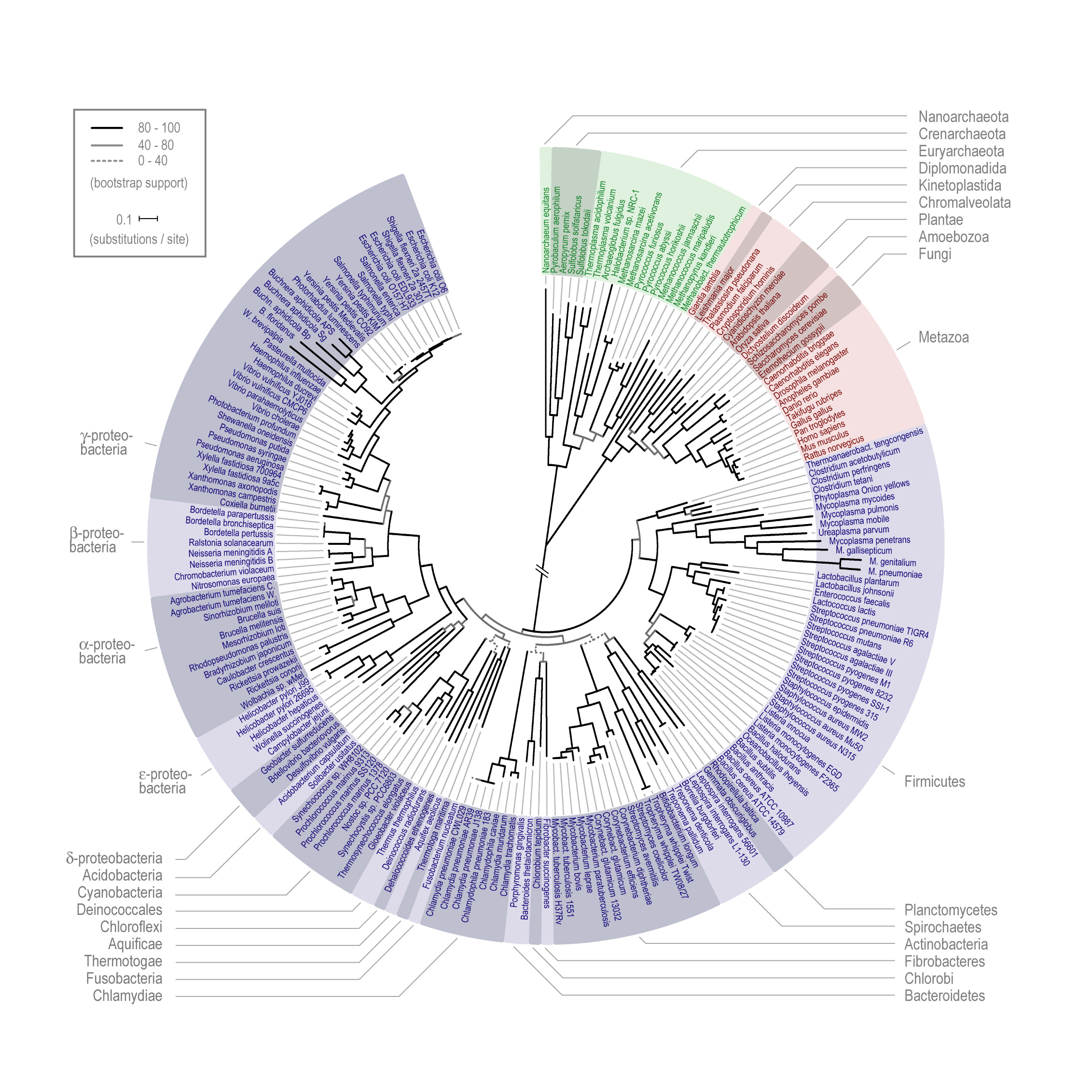
I also like this image of a circular Tree of Life, in which all currently-extant taxa (er, categories of organisms, for the nonbiologists reading!) radiate out from the single hypothesized common ancestor of all. It conveys the never-ending, multifarious nature of evolution much better than any other drawing I've seen.

It will probably not strike regular readers of this blog as news that such a teleological, hierarchical view of evolution has acted as (pseudo-)scientific justification for race- and class-based oppression. This thread has been particularly noticeable in the history of racism: people of African descent have historically been seen as ape-like and "primitive" (i.e., less evolved, less civilized, certainly incapable of governing themselves without white people running the show for them!) by white people.

While I'm not really worried about autistic people oppressing neurotypicals --- we don't have the numbers or the political power or social privilege to do so systematically, although individual autistic chauvinists can, and do, loudly proclaim their neurological superiority on the Internet --- this kind of "Aspie-supremacist" rhetoric valorizing the Vulcan-like, superintelligent-but-socially-naive autistic person can further marginalize autistic people who don't fit that mold. If the autistic-rights movement embraces the "Aspie" to the exclusion of other autistic points of view, then other types of autistics will be right where they were before neurodiversity: voiceless and unnoticed.