Showing posts with label fat. Show all posts

Monday, September 13, 2010

Link Roundup: Fat Is a Feminist Issue Edition

Within the last week or so, there's been a spate of really good feminist blogging about intersections between feminism and fat acceptance.

From Feministe, three guest posts: one by Atheling, who blogs at This Wicked Day, about similarities between slut-shaming and fat-shaming; one by zuzu, who used to be a Feministe contributor and now writes mostly at her own blog, Kindly Póg Mo Thóin, that deals with how fat-shaming health alarmism actually harms fat people's health, both by keeping them out of doctors' offices and by leading doctors to look no further than their patients' BMIs to explain their various health problems; and one by Spilt Milk (who writes an eponymous blog) about how body-shaming permeates mother-daughter relationships and how fat acceptance is radical because it's based on kindness and, well, acceptance, first of yourself and then of others.

There's also this terrific post by Meowser at Fat Fu, which contrasts the reasonable things fat-acceptance advocates are actually saying with the raving denialism everyone else seems to hear:
We say, "Weight is, for the most part, not a very good proxy for health, and there are much better ones, like socioeconomic status." They hear, "Being dozens of pounds over (or under) your baseline weight is just ginchy for you, and your doctor should never bring it up ever." ...

We say, "What causes people to weigh what they do is complex and multifactorial, and varies a lot from one person to another - and you can't tell what people's habits are from their pants size." They hear, "Weight is purely inherited and has nothing whatsoever to do with behavior." ...
...
We say, "Hounding kids about their weight is not likely to result in happier or healthier kids OR adults, for the most part." They hear, "We don't care if all the children lose their toes to dry gangrene by the time they're 12, as long as we can eat all the baby-flavored donuts we want."
Finally, there's this post by Aunt B at Tiny Cat Pants. She talks about two important things that often go unacknowledged in discussions about fat, public health and how U.S. society has changed: first, the class aspects of sitting around waxing oracular about why Those People are so fat and what they must be doing wrong ...
... [W]e talk about obese people having no self-control or being too stupid to know what to put in their bodies or lacking access to experts who could tell them what to do with themselves; the narrative is all about how obese people put all kinds of things in their bodies because they're too stupid (or uneducated to know better) and they thus have really negative life outcomes. Now, read that same sentence and swap out "obese" for "poor."

It works just the same.

I find that interesting. In both cases, it's about a group that has too many people in it, who need education and expertise and guidance, and who are deemed failures or troublemakers if they resist efforts from the outside to improve them.

The word "class" doesn't quite fit, but I think it has to do with demanding people want to strive to remove evidence of what has been deemed their shitty circumstances. Yes, of course, you will be punished for striving. But you will be punished worse for not striving.

It's almost as if the obese/the poor, by their very existence, insult their "betters" by not recognizing and properly responding to their "betters'" expertise on how best to live life.
... and, later, about implicit sexism in how most people --- even most feminists --- talk about fat:
Is it really not clear to feminists how the "obesity epidemic" is about reasserting the right to police women's bodies? Except now, we're doing it for your health!When people talk wistfully about how "nobody cooks at home anymore" who do you think that "nobody" used to be? When people talk about how kids don't get the same free rein of the neighborhoods they used to have, who is the unspoken monitor of all that free time?

Who has, supposedly, fallen down on the job causing us all to be fat?
Spilt Milk also addresses the mother-blaming aspect of obesity panic in her post --- she describes the double bind mothers find themselves in where, if a daughter develops an eating disorder, it's the mother's fault for being too uptight about food and teaching the daughter to hate her body, while, at the same time, if the children are fat, the mother is blamed for being too lazy to cook healthy food and make sure her children get enough exercise!

EDIT: Radical feminist blogger The Bearded Lady has also written two recent posts on fat acceptance: one --- like zuzu's that I linked earlier --- about fat women and doctors, and how doctors both miss underlying conditions that need treatment because they think fat people just need to lose weight, and also how doctors will see a fat woman's fatness as so dangerous, so unhealthy, that they will prescribe extremely aggressive measures to get them to lose weight. Her other entry is about her personal journey toward fat acceptance, and how for her, accepting her body came as part of her radical feminism, and her rejection of heterosexuality:
[A]lthough I had previously strenuously denied any connection between hating my body and wanting men to like me, when I stopped wanting men to like me, I stopped hating my body. Not immediately, in a flash of insight, but gradually, over time, I realised that I was looking at myself in the mirror and not thinking 'ugly' -- not thinking anything at all, really, just looking for toothpaste on my chin or whatever.

Hating my body/self was, for me, expressed not only in extreme dieting and thinking myself deeply ugly, inside and out. I also hated my body by allowing men to use it, by letting men fuck me, when I (the tiny little voice inside me that was barely allowed to speak) knew that I was being violated and used. It was a joyful moment when I realised I could just stop.
I especially liked that entry of hers, because it's probably the closest any other woman has come to describing a relationship to her body, and to the concept of "attractiveness" and whether one possesses it or not, that resembles mine. It's not a total match, and some things are actually very different between the two of us --- I never went through a period of intense dieting and *wanting* to be thin and conventionally attractive like she did, for instance --- the end state she describes is very close to what I have, and it entails a rejection of beauty and attractiveness rather than the reclamation of those things that seems to be a lot more common for large women who learn to love their bodies. I might write more about how that came about for me later, but for now I was just really happy to see someone else articulate these feelings that I also have, and have struggled to characterize accurately.

Monday, May 17, 2010

Fat Panic as Front-Page News (Again)

EXECUTIVE SUMMARY: An article in my local newspaper reporting on the most recent of a long series of studies analyzing data from a large national survey of U.S. children's health has managed to reduce that study's findings to boilerplate obesity-scare rhetoric. The study's author, Gopal Singh, has found that lots and lots of things contribute to a region's, or demographic group's, relative prevalence of childhood obesity, and a lot of those things have to do with economic inequality. But the newspaper article ignores these larger, systemic aspects of public health and seems to promote constant vigilance over children's diet, lifestyle and body size as The Answer to the Childhood Obesity Epidemic. I don't think that's the answer, because dieting for weight loss --- i.e., chronic low-level undernutrition --- is also very bad for people, and it's especially dangerous for children, who are not yet done building the bodies they're going to have to live in for the rest of their lives.
_________________________________

This article in today's Kansas City Star is a pretty good (and by "good" I mean "aggravating") example of the above formula (i.e., fat panic as front-page news).

Let's start with the title: "Study reveals soaring obesity rates among girls." I like those two verbs --- "soaring" obesity rates! It seems like every obesity-related news story uses some kind of dramatic, exciting action verb like that --- soaring, skyrocketing, ballooning, exploding --- or, more rarely, an adjective that conjures similar images of rapid expansion or upward motion, like "stratospheric." And then there's "reveals." While "reveal" is a perfectly good word for talking about research findings --- being a synonym for "show," "demonstrate," "present," etc. --- it also has connotations that whatever is revealed had been hidden, as opposed to merely there waiting for someone to call attention to it. This idea of a menace lurking insidiously under our noses is a staple of alarmist journalism, and has often been used before in equally panicky stories about an Obesity Epidemic.

The study they're talking about is this article in this month's Archives of Pediatric and Adolescent Medicine, which looks at the prevalence of obesity (BMI at or above the 95th percentile for the child's age) and overweight (BMI between 85th and 95th percentiles) among children all over the US in 2003 and 2007, as determined by parents' responses to a nationwide telephone survey about their children's health conducted in both of those years.

The article is actually one of several, all based on different statistical analyses of the same survey data. The lead author of all these studies, Dr. Gopal Singh, is looking at all sorts of different structural and demographic factors for things that correlate to greater rates of obesity within certain groups of people: things like whether people live in walkable communities, how poor they are, their race* and ethnicity, what kind of food they can afford/have time to prepare, how much crime there is in their neighborhoods, whether there are parks nearby, etc.

Here is ScienceDaily's summation of Dr. Singh's most recent findings:
The geographic patterns in childhood obesity are similar to those observed among adult populations, the authors note. Several Southern states -- including Mississippi, Georgia, Kentucky, Louisiana and Tennessee -- were in the top one-fifth of both childhood and adult obesity rates in 2007. For both adults and children, obesity rates were highest in the Southern region and lowest in the Western region.

"Individual, household and neighborhood social and built environmental characteristics accounted for 45 and 42 percent of the state variance in childhood obesity and overweight, respectively," the authors write. "Prevention programs for reducing disparities in childhood obesity should not only include behavioral interventions aimed at reducing children's physical inactivity levels and limiting their television viewing and recreational screen time but also should include social policy measures aimed at improving the broader social and physical environments that create obesogenic conditions that put children at risk for poor diet, physical inactivity and other sedentary activities," they conclude.
(Semantic aside: I love how merely not engaging in physical activity is deemed a "sedentary activit[y]" in its own right in that last sentence. I had no idea you could be so busy not doing something!)

Anyway, one of the weirder things Dr. Singh found in his comparison of the 2003 and 2007 National Children's Health Survey data was two states whose childhood obesity-prevalence numbers almost doubled in those four years. Those states were Arizona and Kansas, with 2007 rates 90.9% and 91.4% higher than their respective rates in 2003.

Also, this increase (which is humongous when compared with the national increase of just 10% over the same period) was only observed in girls. Boys' rates of overweight and obesity did not change significantly between 2003 and 2007.

One thing that has definitely changed between the early and late '00s is the level of sheer panic that's crept into people's attitudes about weight; where maybe before, you might know your child was overweight, and maybe you worried a little about how much weight they might continue to gain once they stopped growing and their metabolism slowed down (or, alternatively, you didn't worry at all because they were still growing!) whereas now, being even a little bit overweight is seen as a life-threatening condition. (You think I exaggerate? Read this. And this. And this. And this. And this. And also, this entire blog).

The study's design protects it somewhat from undue influence of parental attitudes about their children's weight because the parents are not asked whether their child is overweight or obese; they're just asked the child's height and weight (along with, obviously, their age). There's still some room for parental interpretation, in that the parents might have an imperfect notion of what their children actually weigh, and some overly-worried, perfectionist parents might overestimate the weight of a healthy child they're convinced is too chubby. (Or, alternatively, more parents might be actively monitoring their children's weight, due to scaremongering awareness campaigns about Childhood Obesity, and thus more kids who are overweight are having their weights accurately reported). Girls would be particularly prone to this sort of thing, since thinness is so highly prized in girls, and the size of a girl's body is frequently a subject of contention between that girl and her controlling, abusive, judgmental or over-involved parents.

Those factors are more or less constant throughout society, though, and tend --- especially the parental-perfectionism one --- to be concentrated in the demographic categories that didn't see much of an increase in girlhood obesity: white, middle- and upper-class families. The abstract of this other study of the same data makes it clear that most of the increase was seen in poorer children of color.

In general, the groups of people seeing the sharpest increases in childhood obesity over the past four years were the same groups within which obesity is especially prevalent: this is stated explicitly in a study Singh, along with coauthors Michael D. Kogan and Mohammad Siahpush (Kogan, but not Siahpush, is also a coauthor of the state-by-state study) conducted last year, finding that "[s]ocial inequalities in obesity and overweight prevalence increased because of more rapid increases in prevalence among children in lower socioeconomic groups."

However, there is very little discussion of social, economic or policy implications of this research in the Star article; when one social factors do come up is typically in the context of laws mandating certain behaviors at the individual level, rather than addressing any of these underlying systemic inequalities:
Nobody knows why for sure, but girls in Kansas have been gaining weight at an alarming rate.

From 2003 to 2007, the percentage of Kansas girls 10 to 17 years old who were obese nearly doubled, a new federal study shows.
...
Most of the increase in obesity in Kansas may have been among girls who were below high school age, [study author Gopal Singh] said.

About one in three children in the United States is now considered overweight or obese, which is raising concerns about their future health and even their longevity. Many children already are developing diabetes or showing early signs of heart disease that typically are found in adults.

First lady Michelle Obama recently initiated the "Let's Move" campaign against childhood obesity. A government report last week offered 70 recommendations, including healthier food at schools and getting children to exercise more, to combat weight gain.

People who are obese are well above normal weight and have large amounts of body fat. Obesity is usually measured by a calculation based on height and weight called the body mass index, or BMI.

For example, a 12-year-old girl who is 5 feet tall would be considered to be a healthy weight at 110 pounds and obese at 130 pounds.

Singh's study found wide variations in obesity rates among states, even after accounting for ethnic and economic differences.

Kids in Kansas, for example, were twice as likely to be obese as kids in Oregon, which had the lowest obesity rate.

Differences in the availability of parks and playgrounds and in state policies promoting healthy weight among children may play a role, Singh said.

State policies could be a factor in Kansas, said Sarah Hampl, a pediatrician who directs weight management services at Children's Mercy Hospital.

She pointed to a 2009 report by the Trust for America's Health that noted which states had nutrition standards for foods available to children at school or policies for measuring students' BMIs.

"Notably, Kansas was one of the only states in the nation that doesn't have this kind of legislation," Hampl said.
So, while the article does allude to some of the social and environmental factors Singh found accounted for some of the state and regional variation --- it mentions the issue of access to safe outdoor spaces --- it gives more emphasis to solutions addressing children's behavior: restrict what kinds of foods they can get at school, regularly weigh them, etc.

I was particularly distressed to see Dr. Hampl's suggestion that Kansas's lack of school BMI-monitoring policies might explain the state's "alarming" increase in childhood obesity rates appearing just a few inches below Dr. Singh's claim that most of the newly obese or overweight girls in his study are probably preteens; the last thing girls need right as they're going through puberty is some adult scrutinizing their bodies and warning them not to gain any more weight!

*While there is certainly a big role for systemic, economic racism in explaining why people in some racial and ethnic categories tend to be both fatter and less healthy than people in others --- African-Americans, Latin@s and Native Americans are all much likelier than white Anglo-Americans to be poor, unable to afford enough food, and to live in food deserts --- another factor might just be variation in average body type among different ethnic groups. Urocyon has several eye-opening posts about how her body type, which she shares with her relatives and with lots of other people, living and historical, with Cherokee/Tutelo heritage, has been deemed ugly, fat and dangerously unhealthy throughout her life because it doesn't match the thin, willowy ideal of beauty and health that, while it might be unrealistic for most white, European women, too, is even further removed from the actual bodies of most women of color.

Tuesday, September 15, 2009

"The Next Step in Evolution"

(Cross-posted to Turner & Kowalski)

Over at John Elder Robison's blog, there's a two-part guest post on what it's like to be a woman with Asperger's. The guest blogger's name is Deborah McCarthy, and she is 49 years old, a vegan, an animal-rights activist, a Christian, and lives in Oregon.

While most of her writing just deals with her own experiences, particularly the differences she's identified between the way she thinks, feels, and perceives the world and the way most people do (and therefore often expect her to be that way, too), there are a couple of instances where she decides to make general pronouncements about things she really doesn't understand all that well. The statements she makes are inflammatory, hurtful (one more than the other, but neither is totally innocuous) and scientifically illiterate on a grand scale.

First, there's this:
Everybody says Asperger's' main symptom is a lack of empathy but I don't think that's true. Women exhibit differently from men. I'm sure conditioning has a lot to do with it but also women are predisposed from birth to be more empathic I think. I know I cry at the news very often. So I wanted to look at this and other characteristics to get clear on just what I can claim as mine and what just doesn't belong.

Empathy - I'm extremely empathic when it comes to the underdog, animals, children, the poor, the starving, etc. I have no sympathy whatsoever for the obese. Maybe that's from being bullied by my huge family members I don't know. Probably contributed. But for me it symbolizes greed and selfishness at the expense of another. After all, you don't get fat from veggies, you get fat from the flesh and mother's milk of another. Taking what doesn't belong to you. Taking more than your share. Taking more than giving. I have issues regarding fat. I admit it. Try not to hate me for it. I'm just being honest.
There are a lot of things wrong here, but since Sarah has already dealt with this part of the essay I will be brief, and stick to what is factually wrong with this paragraph, since Sarah focused on the failure of empathy involved. (Yes, I noticed the irony in such a massive display of bigotry cropping up as its author is trying to argue that autistics are fully capable of empathy. As they say at Shakesville, *lolsob*).

First: demographically speaking, poor women in America are much likelier than their richer counterparts to be obese. (The picture isn't as clear for men: some studies find that men of all classes are equally likely to be fat, while other studies find a relationship between low socioeconomic status and higher body weight that's significant, if not as pronounced as the corresponding trend among women). Second, it is possible to be fat and malnourished. We've all heard about how various systemic factors (agricultural subsidies making starchy, fatty, processed foods cheaper than produce and whole grains; lack of access to well-stocked grocery stores; lack of time to cook healthy meals, etc.) mean poorer people (who, as I mentioned, are fatter overall than richer people) tend to get a lot fewer nutrients out of their food, even when they're getting enough calories. There are also --- yes, even in the U.S. --- people so poor they can't always afford enough food. And, when bodies aren't getting enough energy, nutrients and raw materials (i.e., sugars, proteins, fats, starches), they start changing their metabolism to compensate for the scarcity. They become thriftier, hoarding more and more of the food they consume as fat.

As Kate Harding puts it:
Poor people are a lot more likely to go through cycles of eating too few calories followed by bingeing --- which, when it's known as "dieting," instead of "only being able to afford enough food sometimes" --- has indeed been shown to make people fatter in the long run.
You also cannot extrapolate whether someone is a meat-eater from their degree of fatness. There are fat vegans and vegetarians, and there are rail-thin omnivores. You can't look at someone's body and reliably predict what they eat. There are too many variables at work for there to be such a cut-and-dried relationship.

And attempting to judge a person's moral character by the shape of hir body? That belongs in the intellectual trash bin with all the earlier pseudosciences conceived along such lines.


Anyway, on to the second thing I found deeply problematic:

I, and others, don't feel that Asperger's is a disorder. I feel it is a neurological difference. You can SEE the difference on a brain scan. We are literally hard-wired differently than a neuro-typical person. (How many times have I said I'm just not wired that way!!) I believe we are a leap in evolution. Leaps like this occur in nature all the time. I believe a more childlike and pure sort of human is on the horizon. One that is less caveman-like and more angelic-like. More ethereal, less dense.

This idea --- that evolution is a linear progression from simple to complex, or primitive to advanced, "caveman" to "angel" --- is very common, but wrong.

The outcome of evolution is not any one species; it's biodiversity itself. It's change in populations over time. Individual variations arise, natural selection acts on them; organisms either propagate their genes or they do not. Intelligence, morality, free will --- or any other objective Good you might be tempted to see (human) evolution as trending toward --- doesn't enter into it.

Evolution is also not hierarchical. Every kind of creature that exists now is equally "evolved," and each constitutes an equally viable solution to the particular bio-engineering problems that shaped its unique evolutionary history.

In other words, there is no Great Chain of Being.

Finally, evolution is not a succession of different attempts to solve the same problem; it's a succession of solutions to a succession of problems. The natural environment is not static: climates shift, continents move, mountain ranges rise up and are worn down, natural barriers isolating potentially interbreeding populations from each other arise or disappear. The selective pressures that act on one generation won't be exactly the same as the pressures that will act on the next generation.

Here's a relatively simple explanation of what evolution is from my college introductory-biology textbook (Biology, Sixth Edition, by Neil A. Campbell and Jane B. Reece):

In the Darwinian view, the history of life is like a tree, with multiple branching and rebranching from a common trunk all the way to the tips of the youngest twigs, symbolic of currently living organisms. At each fork of the evolutionary tree is an ancestor common to all lines of evolution branching from that fork. Closely related species, such as the Asian elephant and the African elephant, are very similar because they share the same line of descent until a relatively recent divergence from a common ancestor. Most branches of evolution, even major ones, are dead ends; about 99% of all species that have ever lived are extinct.

...

We can summarize Darwin's main ideas as follows:

Natural selection is differential success in reproduction (unequal ability of individuals to survive and reproduce).

Natural selection occurs through an interaction between the environment and the variability inherent among the individual organisms making up a population.

The product of natural selection is the adaptation of populations of organisms to their environment.

Thus, there are as many outcomes of evolution as there are ecological niches to be filled.

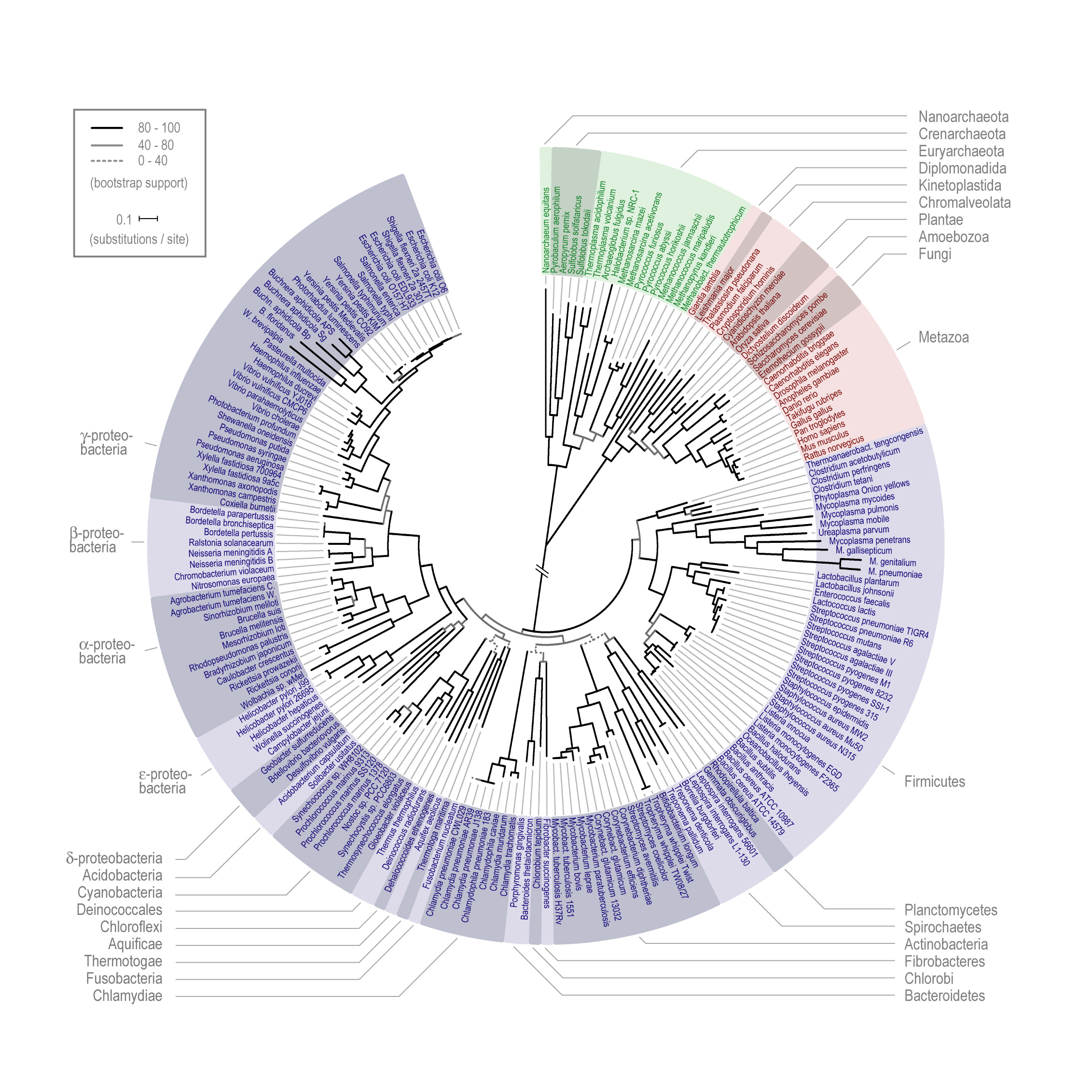
I also like this image of a circular Tree of Life, in which all currently-extant taxa (er, categories of organisms, for the nonbiologists reading!) radiate out from the single hypothesized common ancestor of all. It conveys the never-ending, multifarious nature of evolution much better than any other drawing I've seen.

It will probably not strike regular readers of this blog as news that such a teleological, hierarchical view of evolution has acted as (pseudo-)scientific justification for race- and class-based oppression. This thread has been particularly noticeable in the history of racism: people of African descent have historically been seen as ape-like and "primitive" (i.e., less evolved, less civilized, certainly incapable of governing themselves without white people running the show for them!) by white people.

While I'm not really worried about autistic people oppressing neurotypicals --- we don't have the numbers or the political power or social privilege to do so systematically, although individual autistic chauvinists can, and do, loudly proclaim their neurological superiority on the Internet --- this kind of "Aspie-supremacist" rhetoric valorizing the Vulcan-like, superintelligent-but-socially-naive autistic person can further marginalize autistic people who don't fit that mold. If the autistic-rights movement embraces the "Aspie" to the exclusion of other autistic points of view, then other types of autistics will be right where they were before neurodiversity: voiceless and unnoticed.