Showing posts with label me. Show all posts

Saturday, August 16, 2014

More Pictures of the Tiny Sketchbook for Drawing Tiny Things

It occurred to me after I'd made this post that it would've been a good idea to include pictures of the notebook itself along with the pictures of the things I've drawn in it.

So here they are now!
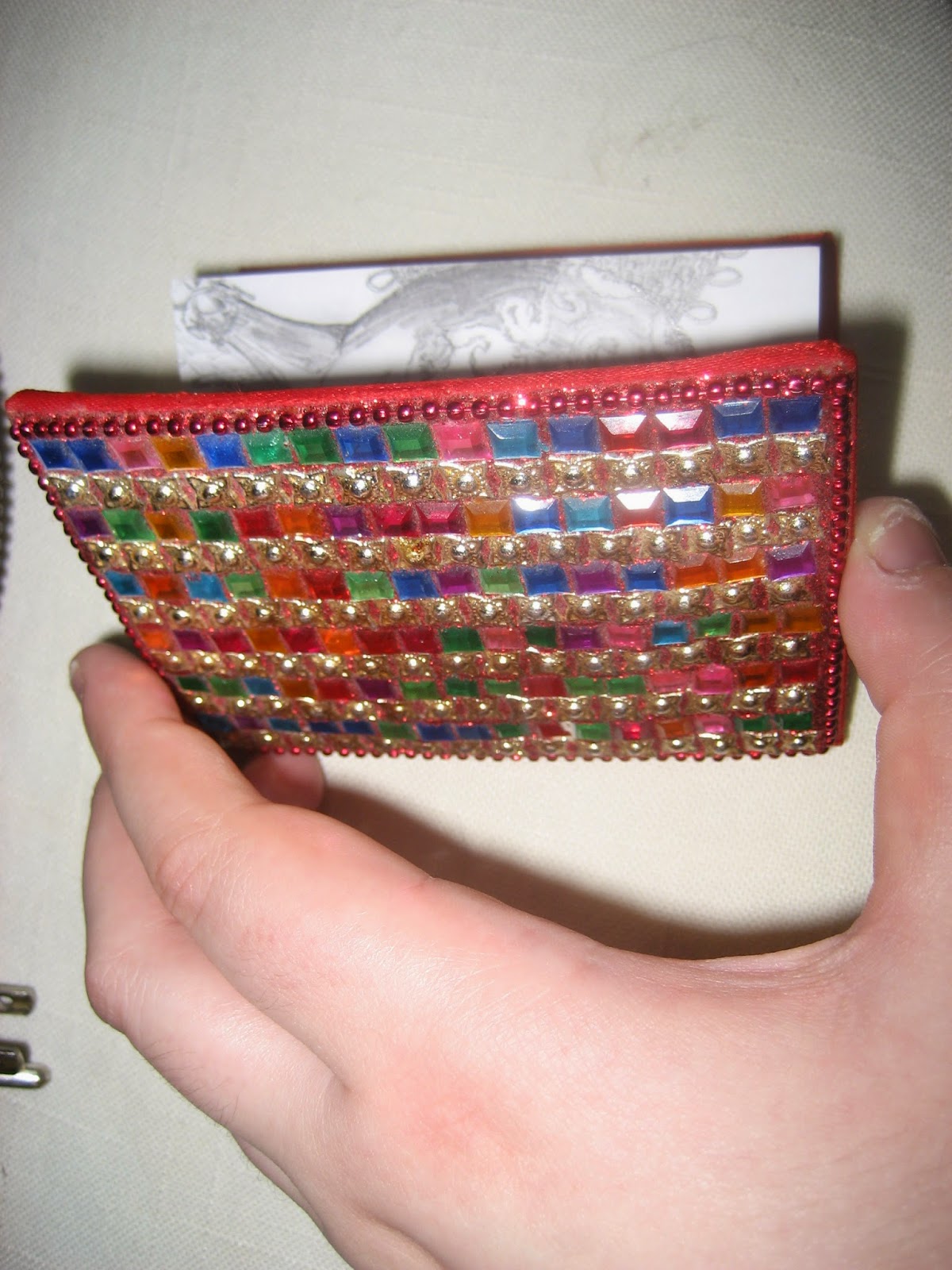
A shot of the cover of my jeweled pocket notebook. It looks like a game of Bejeweled or something ... and it sheds glitter. But it makes me happy to look at it.
Here are some pictures of it in my hand, so you can appreciate just how tiny it is.
Here's a sideways shot of the notebook, with me holding it half open. You can see a little bit of my drawing of a Christmas ornament peeking out from behind the cover.
Here it is sitting on my flat, open hand. This is my favorite shot of it. I like the natural light on the jewels.
Here it is again, engulfed by my hand. It is perhaps an average sized hand overall, though it is pretty large and meaty for a woman's hand.

Thursday, July 17, 2014

A Fairly Silly Art Project I've Been Working On


It's Robb Stark from "Game of Thrones" reimagined as a comic-book superhero!

I made these because someone on Tumblr was asking for fan art of Robb Stark and Jon Snow dressed in revealing superhero costumes, and I figured I could do that.

I made up aliases and powers for them, too, to go with the costumes.

Robb's superhero alias is Grey Wind, and he can fly and control the wind. (Possibly he flies by calling on the wind to carry him?)

I'm still pretty jittery about my skill with watercolors, so I made sure to scan this in stages, so that if I screwed up irreparably at any point I'd still have the linework to fall back on.

(The finished picture is mixed media -- outlined in ink, the figure colored with colored pencils, and the background colored with watercolors.)

Here are the other places I've posted these pictures on the Internet:

On my Tumblr: Stage One Stage Two Stage Three All Together

On my Deviant Art: Stage One Stage Two Stage Three

Thursday, June 19, 2014

Commissions

Doing this drawing made me really excited about drawing people riding comically enlarged animals, so I've decided I'm going to take commissions.

If you want a picture of yourself riding a comically oversized animal -- any animal, even a specific individual (like, if you want a picture of yourself riding your cat), with whatever other specifications you might care to make (what you'd like to be wearing or doing, like if you want to be carrying a banner or aiming or brandishing a weapon or something, or if you'd like to be riding your animal in a specific setting, like up a mountain or through a snowstorm or over the ramparts of Helm's Deep or whatever), PayPal me ten dollars and send me a message (in comments here, in my Tumblr askbox, on my DeviantArt profile page, in an email ... whatever) describing what you'd like me to do.

(Obviously, if I'm going to draw you, I need to know what you look like, so you'll need to send me a picture or a link to someplace where you've posted pictures online.)


My email address (which is also the address of my PayPal account) is lindsayegehring@gmail.com, if you want to take me up on this offer. 

Wednesday, June 18, 2014

Cognitive Styles, Stereotypes and Collateral Damage

(Cross-posted from my Tumblr)

I saw a really interesting post on Tumblr about, among other things, different disability stereotypes and some of the less-than-perfect ways different subsets of cognitively or developmentally disabled people cope with them.

The part of the post I'm responding to:
You know how there is a subset of badbrains people who are like “ACTUALLY, our BADBRAINS MAKE US SMARTER. We are not disabled, we are the NEXT EVOLUTIONARY STAGE, we are BETTER. There is us on the top, then normals in the middle, then unsmart r-word badbrains people on the bottom. Given time they will see.” And I was attracted to that subset of badbrains people for a while before I realise they were assholes (And also stopped being academically smart.) And there was a subset of the subset who said “the unsmart r-word badbrains were just expensive useless people who should die, I NEVER thought that (not that I deserve some kind of “not a murderer” cookie) but those people existed and exist. 
But I feel like there is also a subset of badbrains people who are like “ACTUALLY, our BADBRAINS MAKE US KINDER, we are a PURER  type of human, more whole and loving and sane, more Hufflepuff, than the normals. There is us on top, normals in the middle, and the evil heartless non-sensory, abstraction-based, heartless badbrains people on the bottom, they probably all worship Richard Dawkins and watch my little pony and are racist and rape everyone they meet. They are all just like Elliot Rodger, we should probably kill them before they kill us.”
The bolded parts ring true for me too.
I know that both types of “badbrains people” — the ones whose minds handle abstract concepts well, but don’t really get emotions or people*, and the ones whose minds don’t handle abstract concepts or words well but are good at empathy and perceptual, sensory stuff** — exist and have to deal with ableism from NTs, and have various ways of coping with that and saying, no, actually we have value and are good at things.
And I know that those coping mechanisms can turn into ways of hurting other DD/MI people — the ones whose cognitive styles are as different from our own as they are from the norm. We might think we’re trashing a stereotype but actually be trashing real people who share traits with the stereotype. 
I actually overlap a bit with both of the subsets of people you’re describing — most of the mockery I got in grade school was of the “look at the stupid R-word, she believes whatever you tell her” variety; I do live primarily in a world of sensory information and sometimes I’m not exactly within reach of words; I sort of straddle a line between very concrete, literal thought and more abstract, logical, analogy- and metaphor-based thought; I think very slowly and sometimes speak haltingly; but at the same time I’m very good at academics, including STEM subjects, I can be pretty far removed from my emotions (like, it took me until my 20s to even realize I was capable of certain emotions, or to express them), and I am ridiculously insensitive to nonverbal cues and emotional subtext in conversation.
The latter set of traits make me very much a stereotypical “Aspie” that autistics who don’t have those traits have been bashing as non-representative of what actual autism is like. I’m not really bothered by it because I know they’re right. My observations do tell me I’m in the minority in having those traits, especially the lack of affective empathy
The stuff I’ve seen from other autistic people has been more along the lines of “this type of autistic person doesn’t really exist” than “this type of autistic person is evil,” though.

(From NTs, of course, I've seen a whole lot of "this type of autistic person is evil" stereotyping. It's almost coming to replace the autism stereotypes I remember more from childhood, the ones that imagine us as having no inner life.)

*Continuing with the Harry Potter Sorting Hat theme in the quoted passage, it would probably make the most sense to associate this cognitive style with Ravenclaw, and maybe Slytherin.

**Probably more likely to be in Hufflepuff or Gryffindor

Tuesday, June 10, 2014

Return of the Arty Aspie

Chessmen
I started drawing this a ridiculously long time ago --- like fourteen or fifteen years ago. I drew all the black chessmen, and the closest two of the white chessmen, and shaded less than half of the squares when I abandoned it.

I don't remember why I didn't finish it then; either I got bored of it or I didn't think I could draw the smaller chessmen in the background. 

I've gotten better at working on a small scale since then, so they were fairly easy when I finally came back to it.

Being on Tumblr has inspired me to do a lot more art, so I also made a Deviant Art account.

Wednesday, September 19, 2012

I Am Spartacus! You Might Be Spartacus, Too

So the Judge Rotenberg Center has been in the news again, this time because of an article in New York magazine about Andre McCollins, a young man from Brooklyn who had been sent there in 2001, when he was sixteen. His mother had sent him there because she thought it looked like a pleasant place, with dedicated and competent staff, where he might learn to control the rage attacks he sometimes had. 

Here's the part of the New York article where she talks about what motivated her to enroll him there; it very much gives the impression she didn't know how brutal the disciplinary regime was going to be:
She called the Board of Education for help finding a new school, and an employee told her about the Rotenberg Center. Stepping inside for the first time, Cheryl [McCollins] was dazzled by the décor. There was nothing institutional about this place; the carpet felt five inches thick. "I thought the place was beautiful," she recalls. "I thought these people really took pride in what they did." She loved that residents lived in lavishly decorated houses -- not dorms. The boys wore button-down shirts and dress pants. And there were surveillance cameras everywhere; she couldn't imagine a better way to ensure that Andre wouldn't be victimized again. 
School officials told her about their program and explained how the electric-shock device worked. The staffers showed her a video, too, of other students who'd been hooked up to the GED ["Graduated Electronic Decelerator," the name for the shock device] and appeared to have been completely transformed by it. "I was so excited," she says. "I was like, 'He's going to be cured? This can really stop all those behaviors, the aggression? And he won't break up my furniture, he won't fight?' 'Yes, this device does it.' I was like, 'Wow! You're kidding! Why didn't anyone tell me about this before?'"  
Twenty months into his stay there, Andre McCollins was strapped down and shocked repeatedly for a period of seven hours. The way punishment at the JRC works, they have a list of "behaviors" targeted for each person. Whenever the person does something on the list, they get a shock. Andre's list apparently included such things as screaming and tensing up his entire body, which he did throughout his seven-hour ordeal.

I have to say now that I really, really identify with Andre, even more than I normally identify with the victim in such cases of abuse of disabled children or dependent adults. Andre and I share several things: we're the same age, both born in the year 1984 (poor, poor Andre, he has seen the inside of Room 101), both diagnosed with a pervasive developmental disorder in early childhood. 

Most importantly, we share a pattern of behavior.

The "full-body tense-up."

Obviously, I'm not Andre and I can't tell you what's going through his head when he tenses up his entire body, but I can tell you what it's like when I do it. 

First, some background: though I can speak fluently, I can really only do it when I'm not doing anything else. If I'm intent on something, I won't answer you if you speak to me. I probably won't even acknowledge you until a few minutes later, or until I can tear myself away from whatever it is I'm doing. Especially if I'm doing something mentally taxing, especially something nonverbal and mentally taxing, like math, I may need to wait a few beats to remember how to speak: what the words are, how to put them together in ways that make sense. 

I don't have to be doing hard or creative work for this problem to arise: physical pain and emotional stress are also mentally taxing, and also effectively put words out of my reach for a while. 

As such, my primary response to fear or pain has never been to vocalize. Most of the time it just doesn't occur to me. I react with my body instead, stiffening my posture, recoiling back and tensing every muscle simultaneously. (Sometimes when I'm in pain I also make a hissing noise, but not always). This is what I do whenever anyone touches me. I have reacted that way to touch since I was a baby: my mom says I used to stiffen up in her arms when she tried to hold me. 

It is, you might imagine, a completely involuntary reflex.

So, when I got to this part of the article (TRIGGER WARNING) ---
Usually after Andre got a shock and was restrained, he'd calm down, but on this day he only got more agitated. The more upset he became, the more he tensed up his body -- and the more he tensed up, the more shocks he received. Between 10 a.m. and about 11 a.m., the workers shocked him fourteen times. Each press of the button delivered a loud, high-pitched alarm -- informing employees the shock had been delivered -- while Andre's cries echoed down the hall.
"No, don't do that!"
"I'm sorry. Sorry. Sorry." 
"I won't do it again."
"No, please."
"Stop! Stop! For real!"
"Help me! Help! Help!"
Employees came and went throughout the morning and into the afternoon. They attached two more electrodes, so Andre had five total: on both arms, both legs, and his torso. Following the usual protocol, they tested the batteries on his shock device; rotated his electrodes so they wouldn't leave marks on his skin; offered him water. They studied his "behavior recording sheet" to figure out exactly what behaviors they were supposed to punish. And they documented each shock with the reason it was given: "Scream" or "Tense Up." 
Hour after hour went by and nobody knelt down next to Andre to try to calm him. Attention was considered a reward -- and a student who's exhibiting "targeted behaviors" is not supposed to receive any. When the staffers did speak to Andre, they were required to follow a script, like a case manager did at 1:25 p.m., when she pressed the button for shock eighteen, then said: "Andre, no full-body tense-ups." If any of the workers thought these shocks were excessive, they kept it to themselves. They all knew that if they didn't shock a student when they were supposed to, the phone in the classroom would ring and there would be a monitor on the line ordering them to press the button. 
--- I felt horror, not only at what they were doing to him, but also because they escalated it whenever he physically reacted to the pain. When you realize that, and let it sink all the way in, you see how easily they could have killed him that day. The perverse logic --- tensing up his body (showing fear and pain) is bad, so we will shock him (make him feel fear and pain) whenever he does it until he stops --- reminds you of other no-win scenarios, like the witch trials where they would determine an accused witch's innocence based on whether she sinks or floats in water. If she floats, she's guilty, and her accusers have grounds to kill her; if she sinks, she was innocent, but she's dead anyway.

By now, you're probably asking, "Why is this woman* going on at such lengths about her feelings, and her weird stiffening-up reflex? What does any of this have to do with Andre McCollins?" 

That's a fair question --- I'm not Andre, and I don't have any better idea than you do what he was thinking or feeling on that day. But because of all the things I do happen to have in common with him, I get a strong sense of "there but for the grace of God random chance go I" from his story.

I also believe there's a very strong tendency for non-disabled people to "other" people like Andre McCollins --- they might be horrified at what happened to him, but at the same time they know how impossible kids like him can be. They're aggressive. Violent. They can't be reasoned with. They're a "they," never a "we." People might think they ought to be treated more gently than they are at the JRC, but they have to be put somewhere, controlled somehow, ... don't they?

That's why I have made this post so personal. I'm not Andre, but I share some things with him, and more than anything I think people need to see articles from people who are like Andre in various ways saying, unambiguously, "THIS IS NOT OKAY. IT WOULD NOT BE OKAY IF YOU DID IT TO ME, AND IT IS NOT OKAY THAT YOU HAVE DONE IT TO HIM." If I come across anything Andre himself has written, I will link to it.

*Bitch, to the uncharitable. Cunt, to the vulgar. Perhaps "mewling quim," if you are Loki.

Tuesday, August 7, 2012

Scarab Ring

Clarissa finally inspired me to take pictures of this ring, which I bought on Etsy maybe a year ago, and which is currently my favorite ring.

Here's a shot of my whole hand, so you can see about how big it is:

My hand
Here's a close-up, for detail:
Close-up view of scarab ring, index finger
Three-quarter view, with a clenched fist:
My index finger, balled into a fist. Scarab ring takes up entire length of first finger joint
Side view, so you can see 1) how flat it is, and how thin and light the metal is; and 2) the intricate designs worked into the band:
Where'd the beetle go?!

Tuesday, May 1, 2012

So, Feministe has a pretty interesting post (responding to this article in the New York Times) about family dinner conversations, and how they shape a person's rhetorical style.


Here's how Jill describes her family's dinnertime ritual:
Even when I go home, still, a sit-down dinner and a long discussion is non-negotiable. The TV gets turned off. We don't answer the phone. There are no cell phones allowed at the table. There isn't a structured conversation --- we just talk. And since I come from a family of political junkies, the conversation inevitably turns to politics; since I also come from a family of people who like to push boundaries and challenge each other, the conversation inevitably turns into an argument. No one yells --- we aren't a yelling family --- but voices get raised and sarcasm gets thrown around and even though we're all lefty liberals we get deep into it.
And then we clean up and we watch some CNN and we all move on with our lives. It never occurred to me that dinner-time arguments over, say, farming subsidies or the proper legal treatment of child molesters could create lasting wounds or ongoing anger. Which is maybe why it's taken me years to figure out that, in the blogosphere, you can't come at someone hard in a comment section and expect that they understand you're challenging them because you respect them and find their views interesting, and that they will respond to your challenges and heated critiques with the same, and you'll both walk away still liking each other and not thinking about it much beyond, "Well that was an interesting discussion." Most people just think you're a flame-throwing asshole. I blame my parents.
One person, in comments, mentioned how they felt like the absence of any dinnertime conversation (or, really, any conversation at all beyond the most perfunctory) while they were growing up deprived them of the chance to develop any kind of rhetorical or conversational skills.


My own experiences are like Jill's in a lot of ways: my family, too, sits down for a home-cooked meal and unstructured conversation every night, and does not really consider any subject to be taboo. Certainly not politics, which is discussed frequently. But we don't argue like Jill's family does; we're more conflict-averse, we're not very emotionally expressive (indeed, we tend to be uncomfortable with strong emotions), and, for me at least, argument is not a style of discussion that I am very good at. My mind works slowly, taking time to unfold and absorb every aspect and ramification of whatever I have just been told (besides the fact that I don't think in words and need to "translate" something into the pictorial/abstract colors-and-shapes milieu of my thoughts, and auditory-processing issues mean it takes me longer to decode spoken language than written language, so in conversation I have a particularly long lag time between hearing and understanding), and any thoughts I might have in response to whatever I've just been told also take time to form themselves. I am thus in the position of not yet knowing what I think when it is time for me to speak. I may not even know what you've just said by the time you're done saying it and waiting for me to respond. 


To accommodate this, I tend to treat discussion less as a contest between ideas than as a process of discovering what each person's ideas are


Because I have often found that people's ideas are interconnected in unpredictable ways (including my own), just stating what one thinks about something isn't always enough. Sometimes if you say one thing, the person you're talking to proceeds as if you had said that thing, and a whole bunch of other things you haven't said and aren't sure you even understand. I have also made these assumptions about other people, thinking that I had found a word or phrase to express a bundle of concepts and then finding that, in the other person's lexicon, that word didn't come with all the connotations it carried in my head. So I try and identify the premises I am starting from, and the premises that I and my interlocutor hold in common. From there, I will try to explain how I get to whatever proposition we're debating from those premises, and will also listen to my friend (I can pretty much only do this with friends) draw me a similar map of his or her reasoning.


What Jill's post got me to realize is that this style of conversation, which it has taken me years to develop, might not solely be an accommodation of my cognitive and communicative quirks. It might also be something I have carried with me from childhood, modeled somewhat on the kind of dinnertime conversations my family has.


(Obviously, it couldn't be an exact copy of my family's conversational style, or I wouldn't have had to develop it, but I do feel that what I have jerry-rigged together for myself probably has roots in how my family communicates. It's an adapted version, but I am starting to see some shared features).


Anyway, if you were going to describe my family in terms of what kind of people they are (like Jill describes her family as political junkies), you'd probably call us science nerds. As much as we talk about politics, it's not the thing we talk about most. Most of our dinnertime conversation is of a technical nature, drawing on whatever field each of us is trained in (electromagnetics, chemistry, biology, medicine). Because we are not all trained in the same things, we often have to include a lot of background information leading up to whatever it is we want to discuss. (When my siblings and I were children, this was almost always our dad explaining something about electromagnetics, but now that I have my own body of knowledge and experience, I will sometimes find myself holding forth about chemistry or biochemistry). So my family tends to explain rather than argue, because many of the things we talk about require explanation before they can be discussed in any depth. 


I think now that habit, as much as my needing to slow conversations down and check repeatedly to make sure everyone is on the same page, has predisposed me to prefer a collaborative, expository conversational style to an adversarial, argumentative one, and to feel myself disadvantaged when I do find myself in the middle of an actual debate.     

Tuesday, September 13, 2011

Two New(ish) Necklaces

One of them really is new; I made it a few days ago, and only took pictures of it today.

Here I am, modeling it: (In that light, I have to hold the camera above my head and tilt it downward somewhat to avoid triggering the flash --- it doesn't always work. But it gives a warped impression of how big my head is compared with my neck and shoulders; here's another photo taken from a more straight-on angle: you can see that my neck is actually about the same width as my face at its broadest point. But the top photo is the only one in which I'm not making some kind of "Eek! Flash! Too bright!" face.)
I took advantage of having the camera out and wearing a purple shirt to model another necklace, one I made a while ago.
I don't think any of the pictures I took of this one really do it justice; I really like the way it turned out, with the mix of colors and the little beaded panels, but if I want to get my face in the picture, too, I can't zoom in to show the details that I think are the best thing about this necklace.

With some of my jewelry, the overall shape of it is interesting enough, or big enough, that a photo of me wearing it shows something a photo of just the necklace can't show; I guess the necklaces like the second one shown here aren't in that category.

Thursday, August 4, 2011

Readers, Help Me Name Things!

Etsy has just added a new way to describe the things you've made to make it easier for people to find them; you choose a "style" that describes the general look of whatever it is you've made.

I like this idea, in theory: anything that will maximize my item's chances of showing up in a search is fine with me!

The only problem is, I have no idea what most of the labels mean. (Sometimes I might have a general idea, or know what it means in one area --- like, say, Art Deco architecture --- but have no idea how that same style translates into another area, like, say, jewelry.)
(One of my favorite bracelets of this type: 5-7 strands of one color of seed beads strung through a series of vertical spacer bars woven out of another, contrasting color of seed beads, with a large focal bead set off by a rectangular frame. This one is indigo/blue-green, with the focal bead made of dichroic glass.)(This bracelet is made from the same general pattern; it's grass-green/golden-yellow for its color scheme, though. I also have this in purple).
(Necklace made along the same lines --- multiple strands of dark red beads threaded through a whole bunch of round beads in square frames woven from beads in contrasting colors. This is one of my favorite necklaces!)

So I'm going to ask you, the readers of this blog --- or those of you who, unlike me, have a working knowledge of art history --- to comment and tell me what art-history/fashion terms they think might pertain to the things I have pictured in this post.
(One of those weird things I am not sure what to call. I love these, but the two names I've seen for them --- "handflower" and "slave bracelet" --- strike me as, respectively, dorky and creepy.)

(Another one!)
(One more!)
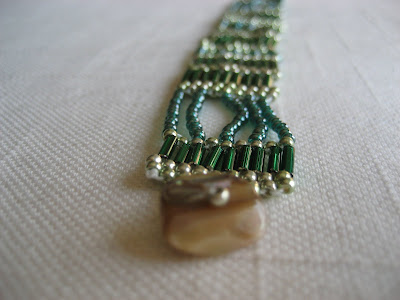
(Another recurring pattern: bracelets/necklaces with ribbed panels woven of alternating, vertical columns of seed beads and bugle beads, in different shades of the same color. I have necklaces in blue, blue/black, and green, and bracelets in purple, green and blue/black)
(I've also got a couple necklaces where the focal elements are arranged asymmetrically --- all clustered to one side)

(For the curious, here's the list of labels they suggest you choose from: Abstract, African (yeah ... European art gets all these very specific terms denoting style and historical period; all African art just gets lumped together indiscriminately), Art Deco, Art Nouveau, Asian (d'oh!), Athletic, Avant Garde, Boho, Burlesque, Country and Western, Edwardian, Fantasy, Folk, Goth, High Fashion, Hip Hop, Hippie, Hipster, Historical, Hollywood Regency, Industrial, Kawaii, Kitsch, Mediterranean, Mid-Century, Military, Minimalist, Mod, Modern, Nautical, Neoclassical, Preppy, Primitive, Regency, Renaissance, Resort, Retro, Rocker, Rustic, Sci-Fi, Shabby Chic, Southwestern, Spooky, Steampunk, Techie, Traditional, Tribal, Victorian, Waldorf, Woodland, Zen. You can also add others, but I'm too confused by all of this to try that. Besides, all the words I know that denote a certain style or subculture are obviously inapplicable to my work).

Friday, June 17, 2011

Guest Blogging

I wrote a guest post about Charlotte Perkins Gilman's book Herland for Her Circle Ezine, a website about women, writing and art.

The post is an expansion on one paragraph in this old post I wrote juxtaposing Herland with Marilyn French's book The Women's Room*.

I expanded this paragraph into a longer essay on how masculinity and femininity are portayed in Herland, which is as complementary performances that distort human nature and interactions between the sexes, and which each depend on the other to work. (Particularly, I look at the character of Terry, and how his brand of brash, overbearing hypermasculinity works against him in the all-woman, but not particularly "feminine," society of Herland.)

Here's the link, if you want to go read it!

*Here are a couple of essays on the same blog that deal with that book; there's also another essay on Gilman, this one about The Yellow Wallpaper.

Wednesday, June 15, 2011

Also

From Sarah's Tumblr:


In light of the recent John Elder Robison interview clusterfuck, I’ve been thinking about something that has long bothered me: the idea that autism—“Asperger’s autism in particular—is so frequently described as “coming across as a jerk without meaning to.”

I don’t doubt that some autistics do experience this, but that’s never been my reality. For me social impairments aren’t as much of a big deal as other autism-related impairments, and of the social issues that I have, I wouldn’t put “being seen as a jerk” anywhere near the top of the list. In fact, on the occasions that I do have this problem, it’s for completely different reasons than what is commonly described. Sometimes I do, yes, act jerky and even cruel—but that’s usually when I’m in the middle of a meltdown or on the verge of one. This is quite different from what JER and a lot of other autism-related material describes. (Of course in JER’s case, I’m pretty sure that a big reason why he is often perceived as a jerk is because he is one. His first book makes this abundantly clear. Hey, autistics can be not-nice people, too.) I’ve said some pretty blunt and possibly inappropriate things, to be sure, but the people who I interact with on a regular basis know that I’m no jerk. That I am in fact a generally nice and caring person. The closest thing that’s come to this was my family “jokingly” telling me that I cared more about the cats than them. But that wasn’t my doing anything possibly jerky so much as a complete misinterpretation of my need for a lot of alone time.

Obviously my experience isn’t representative of all autistics any more than JER’s is. But I’ve met a lot of autistic people, very few of whom can be fairly described as jerks by any definition. And I would be very surprised if a significant number of autistic people listed “being mistakenly seen as a jerk” as one of their top problems. Yet so much of the literature treats this as a central defining feature of being on the spectrum! It’s befuddling, and most likely the product of incompetent, allistic-centric researchers such as SBC fixating—yes, fixating—on the social aspects of autistic impairments to the exclusion of all else.

I meant to include this in my last post, but there got to be so much just about the bit I quoted from that interview that I figured I'd save it for another post.

Anyway, I've been similarly unaffected (well, most of the time --- I can't say that no one has *ever* assumed I was being rude when I was actually having difficulties stemming from autism, like incipient overload, language-processing issues, or whatever, but it is not really a recurring theme in my life) by this thing where people think I must be very rude, or mean, or aloof, because of the way I speak (or don't speak) or act. Some of this may just be because I am a young woman, rather than a middle-aged man, and candor in a young woman might be read as "innocent" or "naive" rather than "rude" --- because I do share some things with Robison, and unthinking candor is one of them --- but it's also because I have other things going on that just social cluelessness. (See: language-processing issues, uneven ability to produce speech, sensory overload, etc.)

Those other things usually mean I get read as stupid, not as a jerk. (Again, that's not to say I absolutely never get read as a jerk --- I might sometimes! That's just not what always happens, or what happens most of the time).

Apart from sharing that, my other motivation in reposting this was to say I very much agree with Sarah's notion that (many) autism researchers zero in on our social difficulties, to the exclusion of other aspects of being autistic that have more of an impact on what we're able to do, and what our lives are like, and how our particular cognitive styles work.

Wednesday, May 25, 2011

Non-Blog Happenings: Turkey Creek Fest

Last Saturday, I made my first attempt at selling my jewelry out in the real world. I bought a vendor space at the Merriam Turkey Creek Festival, which includes a fairly large arts-and-crafts market.

Here's what my booth looked like, more or less:
(I say "more or less" because this picture was taken some time before the event, at my house rather than at the actual site. The festival organizers wanted to see what everyone's setup would look like, so I took some pictures in advance. I did not take any pictures on festival day, so this is all I have).

Here's a closer view of the sign I made:
And here's one of my display elements that I think looks cool, although it's really annoying to set up:Unfortunately, I didn't do well at all in terms of selling stuff --- I only sold two items*, and failed even to make back what I had spent on registration fees! Apparently this year's festival had lackluster turnout compared with what the organizers were expecting; they had planned for 10,000 people showing up, and I didn't think there were anywhere near that many. Most of the other vendors I talked to also had poor sales, although a few did really well. I think one of the reasons I had such bad luck was that there were so many other jewelry vendors --- whoever wanted to buy jewelry had maybe a dozen or more places to do it, and had probably already bought some elsewhere before they got around to my booth.

I don't think it was a total loss, because I had fun, distributed some business cards and learned a few things about picking the right festival to sell what you make --- people are more willing to buy stuff near the holidays, when they are looking for gifts, and different festivals attract different kinds of people, some of whom are more likely than others to want fancy beaded jewelry.

You don't find this stuff out if you never try.

*One of the things I sold was the asymmetrical blue necklace with the circular shell beads shown at the bottom of this post; I made two of those and sold one to my sister a while ago, and now someone has bought the other one, too. I was really proud of the design on that one, so I was gratified to see someone take it (even though it means I can't dig it out and wear it anymore).

Monday, May 2, 2011

Coming Unstuck in Time

Neuroskeptic posted about this case study of two autistic young men who experience "time slips" --- extremely vivid memories, as if they are reliving the past instead of just remembering it:

CASE 1

Case 1, a male patient, was 16 years old at the time of his first visit to our hospital. He had not shown any delay in language development but had been isolated and unable to make friends since his infancy. In addition, he was extremely clumsy. He was extremely afraid of developing liver dysfunction. He had been bullied by a classmate when he was in the 8th grade; thereafter he refused to go to school and began to stay indoors. One day, he clearly recalled bullying incident that had occurred a few years earlier and re-experienced the feelings of fear and frustration as if he were once again experiencing that event. Thereafter, he often had similar experiences, even though he did not purposely intend to recall the event, and he became strongly distressed. He and his family stated that the recalled content was always the same. He thought that the distress could only be relieved by obtaining revenge on the boy who had bullied him, and he visited the boy's house with a knife. He was subsequently admitted to the emergency ward of our hospital.
...
The patient continued to experience the [time slip] even after he was hospitalized. If he saw any man with an appearance similar to that of the boy who had bullied him, he recalled the same experience of being bullied and became violent. The patient's doctor and the ward staff observed that the patient made no effort to avoid the recall stimuli but instead seemed to approach the stimuli. ...

CASE 2

Case 2, a male patient, was 27 years old at the time of his first visit. He had shown no marked clinical signs of delayed language development. However, since an early age, he had exhibited disturbed reciprocal sociality and did not have any close friendships. His interest was limited to collecting figures of comic characters. He began to be bullied during junior high school. He entered senior high school but quit during the second year. Thereafter, he tended to seclude himself at home. One day, he watched his neighbor discarding a cigarette butt in front of his home. Thereafter, he began to be annoyed by that memory. Almost every time he heard the voice of that neighbor or saw that man, he would leave his home and curse at the neighbor. His behavior became more violent and he eventually threatened the neighbor with a wooden sword. Because of this event, his family brought him to our hospital as an emergency patient.
...
In this case, an acoustic or visual stimulus (the voice or appearance of the neighbor) provoked the [time slip] resulting in the recollection of the same visual scene accompanied by the vivid emotions that he had experienced at the actual time. He took no measures to avoid remembering the event and tended to advance closer to the neighbor.

The authors of the paper observed four cases of time-slipping autistic patients in all; two of the troublesome recurring memories involved bullying at school, and two involved bad experiences with neighbors. All of the instances of time slipping that they heard about were bad; the memories triggered strong, unpleasant emotions and drove all four young people (three male and one female) to violence.

I mentioned in the comment thread at Neuroskeptic's blog that I experience this kind of vivid, immersive reminiscence --- it can be like those described in the article, where I remember being bullied or some other unpleasant experience with no buffers between me and it, but most often the things that come up are emotionally neutral, and not even necessarily episodes from my life; they might just be something I've seen before.

An example of the latter sort of memory might be my remembering, for decades, a random doodle I drew in preschool. Even now I can call it up --- a monster's face, with scraggly green teeth and a huge lumpy oval of a head. I even remember what color markers I used to draw it. I have similarly clear memories of making colored spinners out of paper plates, cutting off the edges, using a compass to bore a hole through the middle, and drawing a checkered pattern of concentric rings in contrasting colors. I would string a long piece of yarn through it, with a big, bulky knot on one end, and then spin it so that it would climb up the string and into the air, like a brightly colored UFO. This would captivate me for hours; I probably spent most of my schooldays in fifth or sixth grade doing this.

Most of these are really fragmentary, though; a single image, or a single multisensory impression. I don't really have flashbacks where I relive an incident, as the guys in the article seem to be doing. Even when I do recall an episode, it's only fragmented impressions that come back with this immediacy; the whole episode I have to reconstruct with narrative memory, as most people do.

I said on Neuroskeptic's blog that I considered my randomly retrieved archived sensory impressions to be a visual analogue to echolalia --- I hear echoes in my head of many of the things I hear, and sometimes I feel compelled to repeat them aloud; these memories are like visual echoes. However old they are, they persist, and sometimes they'll find their way into my conscious mind and I will hear the sound, or see the image, again. Even if I first saw it ten, fifteen, or twenty years ago.

Wednesday, April 6, 2011

I Sometimes Make Things

I've been making a lot of jewelry lately; here are some of the most recent things.


1. This bracelet: I really like the black in this one, how it stands out against the blue and creates such a definite border for the different elements.

A closer view of those elements:

Here are a couple views of me wearing* it:


2. A smaller bracelet, that's a bit less visually busy:


There are two things that I like about this one: 1) its texture, with all those bugle beads (the long cylindrical ones) lined up like ribs, and 2) all the different greens I used in it. This one, maybe more than anything else I've made, I just do not get tired of looking at.


3. This necklace I made as a showcase for some nifty glass beads I found (mumble) years ago:
4. Another bracelet, which came out a bit messy, that I made trying to come up with a way to use some of the extra agate beads I didn't use making this or this: ... and 5. A big old cuff bracelet I made to match this necklace:

*Not really wearing it, since I made it to fit a smaller wrist than mine, which my sister says is larger than most women's by about an inch. I have draped the bracelet over my wrist to model it, applying pressure strategically to keep it wrapped around, rather than just lying on, this overlarge extremity.

Friday, January 28, 2011

Heart Necklace

(Also: Reddest Blog Post Ever!)
My brother gave me a gift card for Christmas, and this is one of the things I decided to spend it on: a pewter Human Heart Necklace from Anatomology.com, with a garnet lens hanging alongside the heart pendant.
The necklace is a bit longer than I would've liked --- they sell a shorter version, with a 17" chain rather than the 30" one I have here, but I didn't think the 17" one came with the red stone.
Here I am wearing it in tandem with a red leather rose choker I got at a Renaissance Festival:

(The heart necklace is pulled back a bit so it will sit higher in this picture, so that I could get a better shot of the rose).

Here's the pendant where it normally falls: