Sunday, December 12, 2010

What Is Systemizing?

I've already asked "What is empathy?" on this blog, and, now that I'm working on a series of posts talking about the empirical evidence that exists for Simon Baron-Cohen's "extreme male brain" theory of autism --- which says, briefly, that there are two important skill sets, empathizing (which is more common in female people) and systemizing (which is more common in male people) and that people with autism (whatever their sex or gender) are very poor empathizers and very good systemizers --- I figured I should probably discuss what "systemizing" is supposed to mean, since that question has come up before in comments here.

Baron-Cohen seems to go into the most detail about what exactly he means by "systemizing" in this article describing the construction and testing of a "Systemizing Quotient" questionnaire he and his team devised:

Systemizing is the drive to analyse the variables in a system, to derive the underlying rules that govern the behaviour of a system. Systemizing also refers to the drive to construct systems. Systemizing allows you to predict the behaviour of a system, and to control it. A growing body of evidence suggests that, on average, males spontaneously systemize to a greater degree than do females.

A system is defined as something that takes inputs, which can be operated on in variable ways, to deliver different outputs in a rule-governed way. There are at least six kinds of system: Technical, Natural, Abstract, Social, Organizable, Motoric, but all these share the same underlying process which is monitored closely during
systemizing:


INPUT --> OPERATION --> OUTPUT

Below, an example from each of the six types of system are given:

A. An example of a technical system: a sail
INPUT --> OPERATION --> OUTPUT
Sail.........Angle 10°......Speed slow
Sail.........Angle 30°..... Speed medium
Sail.........Angle 60°..... Speed fast

B. An example of a natural system: a plant
INPUT --> OPERATION --> OUTPUT
Rhododendron....Mildly alkaline soil ........Light blue petals
Rhododendron....Strongly alkaline soil......Dark blue petals
Rhododendron....Acidic soil..................Pink petals
[EDIT 5/13/2011: Commenter meren points out that the different petal colors in response to soil pH --- blue and pink --- is a characteristic of hydrangeas, not rhododendron.]

C. An example of an abstract system: mathematics
INPUT --> OPERATION --> OUTPUT
3...........Squared.........9
3...........Cubed...........27
3...........Inverse..........0.3

D. An example of a social system: a constituency boundary
INPUT --> OPERATION --> OUTPUT
New York....Inner city........Small number of voters
New York....Whole city......Medium number of voters
New York....Whole state.....Large number of voters

E. An example of an organizable system: a CD collection
INPUT --> OPERATION --> OUTPUT
CD collection ....Alphabetical.........Order on shelf: A-Z
CD collection.....Date of release.....Order on shelf: 1980-2000
CD collection.....Genre................Order on shelf: classical --> pop

F: An example of a motoric system: a tennis stroke
INPUT --> OPERATION --> OUTPUT
Hit ball.....Top spin........Ball bounces left
Hit ball.....Back spin.......Ball bounces right
Hit ball.....No spin.........Ball bounces forward

Some of these examples confused me --- how are different geographical entities bearing the same name operations, exactly? I always thought an "operation" was something you do to an input, like squaring, multiplying, dividing, or whatever. Some of these examples have the "operation" be something I would classify as an "input," like the different types of soil for the rhododendron. (Furthermore, what gardener thinks of a rhododendron as a black box into which a certain type of soil goes, and out of which a certain color of flower comes? Most gardeners know a lot more about what is going on inside their plants than that!)

Anyway, here are some alternate examples of each of the type of systems, from a different article:

(1) Technical systems: a computer, a musical instrument, a hammer, etc.
(2) Natural systems: a tide, a weather front, a plant, etc.
(3) Abstract systems: mathematics, a computer program, syntax, etc.
(4) Social systems: a political election, a legal system, a business, etc.
(5) Organisable systems: a taxonomy, a collection, a library, etc.
(6) Motoric systems: a sports technique, a performance, a technique for playing a musical instrument, etc.

(Social systems were the ones that confused me the most, since I couldn't tell if he was talking large-scale --- like you might use sociology, political science or some theory of history to understand --- or small-scale --- interactions between individual people that follow a pattern, that you might use psychology or etiquette to understand, or at least successfully navigate. The second series of examples persuades me that he means the former category of social system).

The first article also addresses the second type of "social system" I envisioned, claiming that social interactions cannot be understood systematically:


[T]he process in systemizing is always the same. One of the three elements (usually the input) is treated as a fixed feature (i.e. it is held constant), while another of the three elements (usually the operation) is treated as a variable (i.e. it can vary: think of a dimmer on a light switch). Merely observing the consequences of those two elements delivers to you important information: the output changes from Output 1, to Output 2, to Output 3. That is, you learn about the system. Systemizing works for phenomena that are indeed ultimately lawful, finite and deterministic. Note that the other way we systemize is when we are confronted by various outputs, and try to infer backwards from the output as to what the operation is that produces this particular output.

Systemizing is practically useless for predicting the moment-by-moment changes in a person's behaviour. To predict human behaviour, empathizing is required. Systemizing and empathizing are very different kinds of processes. Empathizing involves attributing mental states to others, and responding with an appropriate affect to the other's affective state. Empathizing covers not only what is sometimes called "theory of mind" or "mentalizing" (Morton et al. 1991), but also what is covered by the English words "empathy" and "sympathy."


In order to see why you cannot systemize a person's behaviour with much predictive power, consider the next example:

INPUT --> OPERATION --> OUTPUT
Jane.......Birthday........Relaxes
Jane.......Birthday........Withdraws
Jane.......Birthday........Laughs
Jane.......Birthday........Cries

Why does the same input (Jane) have such different outputs (behaviour) when the same operation (her birthday) is repeated? Someone who relies on systemizing to predict people's behaviour would have to conclude that people are not clearly rule-governed. This is a correct conclusion, but there is nevertheless an alternative way of predicting and making sense of Jane's behaviour: via empathizing. During empathizing, the focus is on the person's mental state (including his or her emotion). ... [D]uring empathizing, the observer does not expect lawful relationships between the person's mental state and his or her behaviour. The observer only expects that the person's mental state will at least constrain their behaviour.

In other words, a person might respond quite differently to the exact same set of conditions at different times, depending on how they're feeling, what's been going on in their lives etc. You need access to this information --- not just how they've responded to a given set of conditions in the past --- to make sense of their responses.

Sources:
Baron-Cohen, S. (2002). The extreme male brain theory of autism Trends in Cognitive Sciences, 6 (6), 248-254 DOI: 10.1016/S1364-6613(02)01904-6

Baron-Cohen, S., Richler, J., Bisarya, D., Gurunathan, N., & Wheelwright, S. (2003). The systemizing quotient: an investigation of adults with Asperger syndrome or high-functioning autism, and normal sex differences Philosophical Transactions of the Royal Society B: Biological Sciences, 358 (1430), 361-374 DOI: 10.1098/rstb.2002.1206

Friday, December 10, 2010

Fetal Testosterone and Autistic Traits - Part II: Eye Contact

ResearchBlogging.orgLack of eye contact is one of the first things people will list as a behavioral "tell" for autism; eye contact and related behaviors, like joint attention and what types of things an infant prefers to look at, have all been studied in the past 10 years as potential markers for autism in pre-verbal infants.


This 2002 study (full text here) by Svetlana Lutchmaya, Simon Baron-Cohen, and Peter Raggatt looked for relationships between the amount of testosterone present in the amniotic fluid of 70 British women who had undergone amniocentesis between 1996 and 1997, and how much eye contact those women's children (41 boys and 29 girls) made when they were a year old.

The researchers measured this by filming the children interacting with a parent and a female experimenter over 20 minutes, and tracking the number of times during that period that the infant looked at the parent's face. (The infants were also presented with six different toys during the filmed period, so that they had a choice of what to attend to: their parents' faces or an interesting object).
(Figure 3, in Lutchmaya, Baron-Cohen and Raggatt, 2002 --- scatter plot of fetal testosterone vs. number of instances of eye contact with parents during 20-minute filmed period, broken down by sex)


They found a relationship between fetal testosterone levels and number of instances of eye contact for the mixed-sex group and for boys only, but there was no relationship for girls. There was also an overall sex difference in amount of eye contact made (as well as in fetal testosterone --- all but two of the girls had testosterone levels clustered in a narrow band between 0 and 0.5 nanomoles per liter, with most falling between about 0.3 and 0.4 nmol/L; while the boys had a much broader range of testosterone levels, with most of them falling between 0.5 and 1.5 nmol/L, distributed pretty much evenly along that span, although there were slightly more of them with testosterone levels in the 1.25-nmol/L ballpark than at any other level): girls in general made eye contact with their parents more frequently than boys, to the tune of about 22 times over 20 minutes vs. the boys' 16 times. It should be pointed out, though, that there was a lot of variation within each sex, with plenty of girls making between 10 and 20 attempts at eye contact (where most of the boys seem to be clustered, though there are also a lot of them in the under-10 category, where there are few girls). There also seem to be equal numbers of boys and girls making the most eye contact --- the biggest differences I see are in the medium-high and very low frequency categories, with girls overrepresented in the former and boys in the latter.


For both sexes together and for boys only, the relationship between fetal testosterone and the frequency with which a given child makes eye contact with his or her parent was a quadratic one --- that is, an equation relating [fetal testosterone] squared to number of instances of eye contact plotted a curve fitting closer with the acutal, observed distribution of data points than any straight line that could be drawn through them would fit. (The linear relationship between fetal testosterone and frequency of eye contact was statistically significant, too --- it just wasn't as strong as the quadratic relationship).

Finally, there was a factor that seemed to be almost as strongly correlated to frequency of eye contact as the two major variables being investigated in this study, sex and fetal testosterone: number of siblings. The more siblings a child had, the less often that child looked at his or her parent during the 20-minute interval when the researchers were watching them. This makes sense, when you consider that siblings would all demand an (approximately) equal share of their parents' attention --- the more of them there are, the less one-on-one time each can expect.


Lutchmaya, S., Baron-Cohen, S., & Raggatt, P. (2002). Foetal testosterone and eye contact in 12-month-old human infants Infant Behavior and Development, 25 (3), 327-335 DOI: 10.1016/S0163-6383(02)00094-2

Wednesday, December 8, 2010

Cat Pic of the [variable time period]


Ben, subjecting one of my latest creations to a cat scan.

Tuesday, November 30, 2010

Wheelchair Dancer on Gender and Disability in Everyday Interactions

One of the posts highlighed in today's Recommended Reading post on FWD/Forward was this little gem from Wheelchair Dancer, describing a conversation she overheard.

It was between a man and a woman, about the rules of bridge. The man is explaining something very authoritatively, to which the woman, for the most part, listens passively, occasionally asking questions which the man cannot always answer. It becomes apparent that he's just as new to the game as she is --- he's just assumed the role of The Authority in this conversation, even though he's no more an authority on bridge than she is.
As far as the negative power relation between men and women goes, this conversation, sadly, would not stand out were it not for the way in which the woman responds to the answers she gets.

For every thing she doesn't understand right off the bat or simply gets wrong, she claims a disability. So far, she has memory issues, is dyslexic, is losing her mind, is "slow ...". As I listen to her, I suppose that any or all of these things could be true. ... Nonetheless, as the stream of different disabilities continues, I begin to wonder if claims of disability function as a cushion between the painful abruptness of her partner and her desire to do better and earn his acceptance. In other words, the woman may be disabled in all those ways, but in the context of the conversation, disability also serves as an excuse/reason for her "stupidity" in the face of her partner's "brilliance."

Wheelchair Dancer doesn't think it's an accident that the woman's (apparent) disability functions like this --- to diminish her presence, shrink her further and further into the background --- she sees this uncomprehending silence, this unquestioning acceptance of the man's greater expertise, this constant deprecation of her own understanding, as part of the way the woman has chosen to "do disability":
She does disability in the old way, a way in which the value of our diverse minds and bodies is not acknowledged. Her disability is a weakness that separates her from an actively feminist goal of being an equal partner in the conversation and the game.
Rather than stop the conversation and ask the man to go slower, repeat something, or rephrase or elaborate on something until she feels she understands what he's trying to say and can either agree with it or challenge it, she stays quiet, unwilling or unable to ask him to adjust his manner of speaking to her needs. She's shrinking herself, subordinating herself to him, taking part in the conversation either on his terms and at his pace or not at all.

A commenter pointed out that, from the way Wheelchair Dancer described him, the male half of this duo could very well have some communication impairments of his own --- on the "sending" rather than the "receiving" end.

I think they might be right, because there are elements of Wheelchair Dancer's description of the man's conversational and interpersonal style --- his rigidity, his lack of eye contact, the apparent effort with which he speaks --- that are in fact features of a disability I have, which does interfere with my ability to communicate via speech.

But even if that's true, and the man, too, has some communication impairment that's making him have to work very hard even to put his thoughts into words at all --- let alone rearranging and streamlining those words so that they are intelligible to the woman, who seems to have receptive language difficulties --- the man would still be using his disability to silence the woman, to shut her out of equal participation in the discussion.

By dominating the conversation, by taking on the role of The Authority, he's still saying that, whatever impairments he may have, he's the one setting the terms for this interaction.

Also, even if they both have disabilities affecting their ability to communicate, she's the only one who ever references them --- and she only references her own disabilities, and that in a self-deprecating way, not in a way that indicates she's asking the man to accommodate her. Whether the man has a disability of his own or not, he's set himself up as the standard against which she has to measure herself. Does she understand his sentences? If she doesn't, there must be something wrong with her, because they're totally clear to him!

So, still working under this assumption that both participants in this conversation have language difficulties (receptive or expressive), we find that both partners have different ways of "doing" disability, and --- surprise! --- both of them involve the woman shutting up and retreating into the background.

Sunday, November 28, 2010

German Museum Exhibits Works by Neurodiverse Artists

One of my uncles is a professor, and spends part of each year teaching in Moscow. This year, on his return trip, he ended up spending a bit more time than he had anticipated in Germany, which he spent hanging around in Frankfurt.

While he was there he came across this exhibition at an art museum called Schirn Kunsthalle Frankfurt: "World Transformers. The art of the outsiders."

The exhibit features works by people who see the world in unusual ways:
Thinking outside the norm can result in fantastic works. Linked to creative abilities, to mental states that deviate more or less from the "normal," the everyday, Outsider artists reveal the unexpected in their works. Often located on society's margins, they illuminate the frontiers and contradictions of human existence, communicating a profound unease about the relationships between reality and fantasy. They direct our gaze onto the more opaque paths of thinking and offer an occasion to ask fundamental questions.
The artists whose works make up this exhibit come from different countries, and different times: from the 19th century to the present.

Some of them are:

George Widener, an autistic man currently living in Asheville, North Carolina who has a prodigious memory and savant abilities in mathematics, particularly calendar calculations. He taught himself to draw, and has created sprawling, intensely detailed ink drawings of futuristic cities, like this one, "Megalopolis 22" --- --- and this one, "Megalopolis 21":
He also draws these unique numerical portraits of people, making magic squares out of significant dates in their lives. Here, for example, is "Queen Victoria". His calendrical creations aren't solely biographical, either --- he's done squares showing dates in all sorts of other patterns, too, like "Month of Sundays," a sequence of thirty Sundays derived from a thirty-year period in the 23rd century and arranged in order from 1 (June 1, 2200) to 30 (August 30, 2229). The day (of the month --- the day of the week is always Sunday) and the year advance by one in each succeeding square.


Madge Gill, an English visionary artist who lived from 1882 to 1961. She was a Spiritualist, and believed herself guided by a spirit called "Myrninerest" who was the source of her drawings.

The drawings often depict women --- glimpses of women's faces, peeking out from under hats: Other drawings do not have figures in them at all, just geometric shapes and surfaces patterned with checkerboards coming together at odd angles: August Walla, who was born in 1936 and died in 2001, and spent his life from 1983 onward in a community of artists who were also psychiatric patients at the Lower Austrian Psychiatric Hospital in the town of Gugging, near Vienna.
He had a mythology, cosmology and symbolic vocabulary all his own, which he developed and expressed in his paintings.
Here is his room in the Haus der Künstler (Artists' House) where he lived; he painted on every available surface.


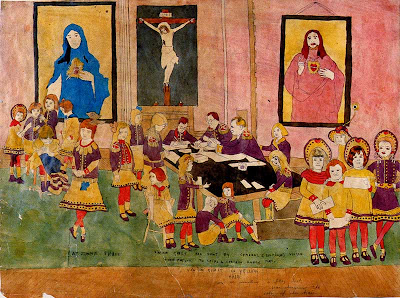
Henry Darger, who was institutionalized as a child in 1905, lived a hermit-like life in Chicago, Illinois until he died in 1973. He wrote fantastical stories about seven sisters who are princesses of a rebel (Christian) nation on another planet, fighting against a tyrannical alien species that uses human children as slaves. He was devoutly Catholic, and went to Mass every day, sometimes several times in a day. His visual artworks, beautiful and delicately painted watercolors of children, were illustrations for his stories.

Amanda Forest Vivian has a post from a while ago about him.

There are more artists featured in this exhibit, but I've already spent a whole lot of time hunting down biographies and representative works from these four --- I had wanted to do all the artists named or otherwise represented on the Schirn webpage, with little capsule biographies and an image or two for each one, but that turned out to take a lot longer than I thought it would, and I wanted to have a post that didn't take me days to write for once.

But anyway, these artists are all awesome, some of them are even still living and making money off their art! So I definitely recommend going to this exhibit (which will be open into January) if you're in Frankfurt or can get there easily.

Sunday, November 21, 2010

Beyond Bizarre: Some Highly Speculative Retrodiagnosis

(When you've only got one piece of the puzzle, you can put that piece anywhere you like)


Probably because it's still so poorly understood, autism seems to be something of a lightning rod for off-the-wall ideas.

Some of these crackpot conjectures try to contextualize autism's fairly recent discovery, either by drawing a spurious connection with some other recent historical development (widespread vaccination is a popular one), which is supposed to have given rise to autism in the first place, or by spinning out a putative history for autism predating Leo Kanner's 1943 article defining it.

One of the ways of doing this --- cobbling together a History of Autism Through the Ages, when scientific and medical literature about autism began almost halfway through the last century --- is by looking for traces of autistic traits in the life stories of famous historical figures. This is also a spurious exercise, because there aren't anywhere near enough written records from centuries ago detailing people's (even famous people's) infancy and childhood, and getting someone's developmental history is part of the process of diagnosing autism.

However, even considering that the field of autism --- and especially autism's history --- has a pretty high baseline level of speculation and conjecture, I think this article's thesis still stands out among the most bizarre claims ever made about autism.

The article --- published in the current issue of the Annals of Indian Academy of Neurology --- matches up various characters in the Old Testament of the Bible with the neurological disorders the article's authors think they might've had; one such pairing is their suggestion that Samson may have been autistic:
The book of Judges, in Chapter 13 talks about Manoah and his wife, and the child promised to them by God: the child who is named Samson. The subsequent chapters go on to tell us about Samson's search for a wife, his extraordinary physical powers, which helped him win numerous battles. Various researchers and scholars who have studied the life of Samson have offered Guillain-Barre Syndrome and Myasthenia gravis as possible diagnoses. We would like to offer autism as a possible diagnosis for Samson.

The diagnosis of autism is on the basis of behavioral criteria: qualitative impairments in social and communicative development, with restrictive and repetitive activities and interests. It is written in Judges 13:25 that he had violent movements of the body at times in the camp of Dan between Zorah and Eshtaol. This could have been an instance of recurrent seizure episodes. Two separate studies carried out in New York and Sweden state that the incidence of epilepsy is greater among children with autism than in the general population. However, it must also be stated that the greatest risk factor for epilepsy among autistics were severe mental deficiency with a motor deficit, both of which were not evident in Samson.

One of the earliest incidents recorded from Samson's adult life is the journey to Timnath with his parents where he tears a lion with his bare hands. On his return, he finds a swarm of bees and honey in the carcass of the lion, which he eats, and offers his parents (Judges 14:8-9). Abnormal eating is one of the atypical behaviors noted among children with autism.

[Francesca] Happe states that autistics may exhibit a failure to understand deception (manipulating beliefs) but achieve success on control tasks involving sabotage (manipulating behavior). This may be correlated with the fact that Samson believed his strength lay in his hair, which would be lost if his head were ever shaved (Judges 16:17), and that he succumbed to his wife Delilah's wiles (Judges 16). Throughout Samson's life, it is seen that he performed extraordinary physical feats. In Chapter 14, he tears a lion with his bare hands "as he would have rent a kid" (verse 6); in Chapter 15 he kills 1,000 Philistines with the jawbone of an ass; and in Chapter 16 in his final act, he causes the house in which he was held captive to fall by pushing against two pillars that he was tied to, killing more men than he ever did in his life, and in doing so sacrificing his own life. It is possible that Samson was able to perform these feats as he may have been insensitive to pain, which is occasionally seen among autistics. A study of hospitalized individuals carried out in Sweden had reached the conclusion that individuals with autism or autism spectrum disorders are prone to acts of violence.
So, to summarize, here is their evidence for thinking Samson might have had autism: he ate something weird once, he could be deceived, and he was exceptionally strong and a fearsome warrior. That's a paltry basis for a diagnosis even before we consider the unreliability of the Bible as historical record; it might sometimes describe historical events, but it should really be considered more in the light of myth or legend than of factual record.

Indeed, trying to write history while starting from the premise that everything written in the Bible is literally true often leads to absurdity. Some examples: in his book Bad Astronomy, Philip Plait describes the bizarre, and physically impossible, theories of Immanuel Velikovsky, who sought to prove that the events in the book of Joshua, where Joshua stops the sun in the sky to lengthen the day so that the Israelites would win a battle, could really have happened. Velikovsky's infamous book, Worlds in Collision, proposes that the planet Venus was not formed at the same time as the rest of the solar system, but instead split off from Jupiter much later as a comet, zooming around the inner planets causing havoc until it settled down in its current orbit between Mercury and Earth. One of the things Venus supposedly did in this itinerant stage is to pass by Earth very closely, slowing down the speed of Earth's rotation on --- you guessed it! --- the very day that Joshua was waging this crucial battle and had such dire need of a few hours of extra sunlight.

It would be much easier (not to mention more believable) to read the account of the sun stopping in the sky, and similar impossible events or superhuman deeds described in the Bible, as poetic exaggeration than it would be to try to come up with a physical explanation for every single one of them!

Back to Samson, briefly: even apart from the problems inherent in treating the Bible as a totally objective, accurate source --- look back at the second-to-last paragraph in the quoted passage, where they find evidence of Samson's peculiar eating habits in a story about him dismembering a lion with his bare hands, for Pete's sake! And yet they thought this passage sufficiently true-to-life that they could take even its smallest details as fact? --- the things they choose to highlight as suggestive of autism aren't all that suggestive.
The unusual eating behavior, for instance, that they cite in the episode with the bees and honey in the lion's body? That --- while it is certainly very odd --- deviates from most people's eating behavior in the opposite way that most autistic people's eating habits do. Most of us are very picky eaters, who are grossed out by, or just can't stand, lots of perfectly ordinary foods; very few of us would scoop a handful of bugs out of a rotting corpse and pop them in our mouths!

I'm also extremely skeptical of the idea that mere insensitivity to pain would grant you the kind of superhero-like strength and toughness that are Samson's most salient traits. After all, not being able to feel pain doesn't make you indestructible. You can still break bones, sustain massive tissue and organ damage, and die --- you just won't feel it. Someone who can overpower a thousand (presumably armed) men with just a donkey's jawbone for a weapon has something more going for him than just that.

Neuroskeptic and Autism Jabberwocky also have posts up about this odd little paper.

Friday, November 19, 2010

Fun With Gender Genie

Over at Left Brain/Right Brain, the bloggers and commenters are having fun with J.B. Handley's assertion (at Age of Autism) that LB/RB blogger Sullivan is really Bonnie Offit (wife of Autism's False Prophets author Paul Offit) wearing the cyberspace equivalent of a fake beard.

In this post from yesterday, Kevin Leitch (the primary LB/RB blogger apart from Sullivan) ran samples of both J.B. Handley's and Sullivan's writing through a web-based gender-guessing algorithm called Gender Genie, which prompted many of the commenters to submit some posts of their own for gender analysis.

I thought I would join in the fun myself, but then I had the idea to compare my results by category of post --- is Gender Genie more likely to think me female if I write about some things than if I write about others? --- and realized that reproducing those results would take up a lot more space than a typical blog comment.

So I'm posting it here.

My hypothesis: the more technical posts will be judged male most of the time. Autobiographical posts, literary posts, and probably feminist posts will be judged female most of the time.

Posts about research articles:
"Through a (Brain) Scanner, Darkly" - 1557 words
Female Score: 1004; Male Score: 2112
Gender Genie thinks the author of this passage is ... male!

"Who's That in the Mirror? Autism and the Developing Sense of Self" - 2091 words
Female Score: 3093; Male Score: 3036
Gender Genie thinks the author of this passage is ... female!

"These Are Not the Eternal Verities of Biology - Part II" - 831 words
Female Score: 884; Male Score: 1374
Gender Genie thinks the author of this passage is ... male!

"Fever Dreams: Autism Research and the Changeling Myth" - 1010 words
Female Score: 1311; Male Score: 1520
Gender Genie thinks the author of this passage is ... male!

"Thoughts on the 'Extreme-Male-Brain' Theory of Autism" - 921 words
Female Score: 682; Male Score: 1467
Gender Genie thinks the author of this passage is ... male!

"Autism, Alexithymia, and Empathy" - 1673 words*
Female Score: 1524; Male Score: 2132
Gender Genie thinks the author of this passage is ... male!

"Say What?!" - 1061 words
Female Score: 997; Male Score: 1771
Gender Genie thinks the author of this passage is ... male!

"I Wanna Be Sedated" - 2518 words
Female Score: 2895; Male Score: 3922
Gender Genie thinks the author of this passage is ... male!

"Autism and Genetics: It's Complicated" - 1526 words
Female Score: 1657; Male Score: 2295
Gender Genie thinks the author of this passage is ... male!

Average scores for this type of post: 1485 female; 2181 male
Average post length in this category: 1465 words

Posts about my life:
"Doubly Deviant: On Being Queer and Autistic" - 2497 words
Female Score: 3343; Male Score: 2881
Gender Genie thinks the author of this passage is ... female!

"An Act of Shameless Emotional Exhibitionism" - 1025 words
Female Score: 1841; Male Score: 857
Gender Genie thinks the author of this passage is ... female!

"Gender Variance in Autism: How Much of It Is Just Sensory?" - 1100 words
Female Score: 1317; Male Score: 1647
Gender Genie thinks the author of this passage is ... male!

"A Brief Experiment in Communal Living" - 1129 words
Female Score: 1488; Male Score: 1462
Gender Genie thinks the author of this passage is ... female!

"Addendum" - 716 words
Female Score: 709; Male Score: 958
Gender Genie thinks the author of this passage is ... male!


"Employment Issues in Autism: Finding and Holding a Job" - 792 words
Female Score: 1122; Male Score: 968
Gender Genie thinks the author of this passage is ... female!

"What's It Like to Be You?" - 677 words
Female Score: 660; Male Score: 1040
Gender Genie thinks the author of this passage is ... male!

"Bringing the Doctor-Patient Relationship Into the Bedroom"** - 991 words
Female Score: 1642; Male Score: 1581
Gender Genie thinks the author of this passage is ... female!

Average scores for this type of post: 1515 female; 1424 male
Average post length in this category: 1116 words

Book reviews/literary criticism:
"Totally Unexpected Gender and Disability Awesomeness from Larry Niven" - 1500 words
Female Score: 1844; Male Score: 2266
Gender Genie thinks the author of this passage is ... male!

"In or Out? Using Spatial Metaphors to Describe Autism" - 2459 words
Female Score: 1936; Male Score: 3877
Gender Genie thinks the author of this passage is ... male!

"A Flash-Flood of Feminist Fiction" - 2299 words
Female Score: 2242; Male Score: 3720
Gender Genie thinks the author of this passage is ... male!

"More about Jude the Obscure" - 1423 words
Female Score: 1980; Male Score: 1956
Gender Genie thinks the author of this passage is ... female!

"Autism in the Not-Too-Distant Future: Thoughts on Elizabeth Moon's The Speed of Dark" - 641 words
Female Score: 658; Male Score: 934
Gender Genie thinks the author of this passage is ... male!

"Metaphor at the Expense of Characterization: Autism in Margaret Atwood's Oryx and Crake" - 1166 words
Female Score: 1310; Male Score: 1360
Gender Genie thinks the author of this passage is ... male!

"Comparing Feminist Dystopias" - 1005 words
Female Score: 1053; Male Score: 1417
Gender Genie thinks the author of this passage is ... male!

Average scores for this type of post: 1575 female; 2219 male
Average post length in this category: 1499 words

Posts about feminism:
"Oh No, an Analogy!" - 678 words
Female Score: 537; Male Score: 1145
Gender Genie thinks the author of this passage is ... male!

"But What About the (Aspie) Men??!" - 1504 words
Female Score: 2464; Male Score: 2675
Gender Genie thinks the author of this passage is ... male!

"A Bit More on Reproductive Choice" - 1234 words
Female Score: 1167; Male Score: 1439
Gender Genie thinks the author of this passage is ... male!

"Disability Rights and Bodily Autonomy" - 694 words
Female Score: 1216; Male Score: 842
Gender Genie thinks the author of this passage is ... female!

"Violence Against Disabled Women" - 1660 words
Female Score: 2610; Male Score: 2365
Gender Genie thinks the author of this passage is ... female!

"Where Neurodiversity Meets Feminist Theory (Part III)" - 607 words***
Female Score: 1021; Male Score: 1121
Gender Genie thinks the author of this passage is ... male!

"On Patriarchal Medicine: The Intersection of Feminist Critique and Anti-Vaccine Crackpottery" - 588 words
Female Score: 695; Male Score: 1078
Gender Genie thinks the author of this passage is ... male!

Average scores for this type of post: 1241 female; 1363 male
Average post length in this category: 995 words

Other political/philosophical posts:
"Human Diversity and the Surveillance State" - 606 words
Female Score: 663; Male Score: 860
Gender Genie thinks the author of this passage is ... male!

"More Focus on Compliance: An Addendum to My Last Post" - 518 words
Female Score: 646; Male Score: 840
Gender Genie thinks the author of this passage is ... male!

"A Tale of Two Epidemics" - 677 words
Female Score: 949; Male Score: 1269
Gender Genie thinks the author of this passage is ... male!

"Employment Issues in Autism: Trends" - 770 words
Female Score: 800; Male Score: 1172
Gender Genie thinks the author of this passage is ... male!

"New Concept: Context Disorders" - 465 words
Female Score: 857; Male Score: 808
Gender Genie thinks the author of this passage is ... female!

"Is Bullying a Feature of Our Culture, or a Bug?" - 663 words
Female Score: 1155; Male Score: 1144
Gender Genie thinks the author of this passage is ... female!

Average scores for this type of post: 845 female; 1016 male
Average post length in this category: 617 words

While I've tried to pick posts that are either free of quotations entirely, or have a fairly high proportion of my writing to other people's writing (this ruled out some of the research-article posts that I'm quite proud of, and would otherwise submit as representative of my writing), or were purged of overly long quoted passages, the samples I gave were still not 100% written in my voice. Especially the literary and science-related posts: if you're writing about another piece of writing, whether it's a book or a research article, you're probably going to have to quote it at some point.

I can't tell the extent to which this has biased the gender classification of my posts; with the research-article posts, I'd expect the gender of the lead author not to have much of an effect since research articles are written in such a uniform, dry, trying-to-be-objective style. With the book posts, it turns out all but one of them are judged to be written by someone of the opposite gender of the author whose book I'm reviewing. (The lone exception is the post on Larry Niven's The Integral Trees, which Gender Genie determines was written by a man).

(Also lumped in with those book posts is a more generic literary-type post about the use of spatial metaphors to describe autism; in it, I cite and quote from an article by the philosopher Ian Hacking. The Genie also decided that post was written by a man, but it had a pretty high ratio of my writing to Hacking's writing that I'm less likely to think quoting from him biased that reading than I am to think my liberally quoting Larry Niven's book might've biased the gender-determination of that post).

Something I expected, since I noticed that all of the pronouns seem to read as "feminine" words to Gender Genie, was that my autobiographical posts would tend to be classed as female-written. This turned out to be the case: of the eight posts I chose to run through the program, five came out female and three came out male.

Both my posts about feminism, and my posts about political, philosophical or cultural topics in general were overwhelmingly judged male. I separated out feminism from the other political/theoretical writing to see if Gender Genie seemed to consider content at all; I guess it doesn't.

For the most part, it does seem to think I'm a man, though.

*There is a lengthy quotation near the end of that post that I omitted from the text I sent through Gender Genie, so this figure falls a bit short of the actual length of the post.

**This post could just as easily be considered a literary or feminist post: it's a comparison of a dynamic I observe in my (heterosexual) romantic relationship to similar dynamics in books --- F. Scott Fitzgerald's Tender Is the Night and Charlotte Perkins Gilman's The Yellow Wallpaper --- bookended with a little bit of feminist history/theory. So it has all three elements; I just figured the autobiographical element was most prominent.

***Again, excluding a fairly long quotation.

Thursday, November 18, 2010

Autism-Related Gene Spotlight: CNTNAP2

EXECUTIVE SUMMARY: CNTNAP2 is a large gene near the end of chromosome 7 that encodes a cell-adhesion protein involved in distributing ion channels along axons (the long tails of nerve cells) and in attaching the fatty cells making up the myelin sheath to the surface of the axon. DIsruptions in this gene have been associated with autism, epilepsy, Tourette syndrome and other neurodevelopmental disorders. Variations at certain points within the gene that don't alter or disrupt its expression have also been associated with an increased likelihood of autism.
_____________________________________________
Where is it?
Chromosome 7, in the 7q35 region (i.e., near the end of the long, lower arm of chromosome 7).
CNTNAP2 is, according to Entrez Gene, one of the largest single genes in the human genome; it's about 2.3 million base pairs long, taking up 1.5% of the total space on chromosome 7.

What does it do?
CNTNAP2 encodes a cell-adhesion protein called contactin-associated protein-like 2 (Caspr2), which is part of a superfamily of adhesion proteins specific to nerve cells called neurexins.

During development, Caspr2 plays an important role in organizing the long tail of the neuron, called the axon. Caspr2 directs certain types of voltage-gated potassium ion channels (i.e., channels that open or close in reponse to changes in membrane potential) to insert themselves into the axon's membrane at specific intervals; it also forms part of the junction between the axon and the fatty glial cells that form the myelin sheath around the axon, which both insulates the axon (like the rubber tubing around a wire insulates the wire) and allows the electrical current to travel faster, in a discontinuous, hopping ("saltatory") manner from node to node along the myelinated axon.

(Image adapted from
Wikipedia)
To allow the current to travel discontinuously, the fatty cells making up the myelin sheath leave small stretches of axon uncovered at regular intervals. These unmyelinated points are called the nodes of Ranvier, and it is at these nodes that Caspr2 plays its traffic-directing role.
(Node of Ranvier and surrounding regions; taken from Figure 4 in Poliak and Peles, 2003)

Caspr2 sits in the membrane of the axon in its juxtaparanodal region (which means, "the region right next to the region next to the node" in ScienceSpeak), where its cytoplasmic domain (the part of a membrane-spanning protein that's inside the cell) links up with potassium ion channels prior to their insertion in the membrane, and directs them to insert adjacent to the complex of adhesion proteins including Caspr2. This ensures that the potassium channels all cluster together in the juxtaparanodal region, rather than distribute themselves more or less evenly along the axon, as they would do without guidance from the adhesion proteins.
This superabundance of potassium ion channels near the nodes of Ranvier makes the nodes hypersensitive to membrane depolarization (which is mediated by traffic of ions, including potassium, into and out of the cell), which allows an action potential (the "firing" of a neuron that happens once it reaches a certain threshold level of membrane depolarization) to be transmitted from node to node more easily.

This gene may also play a role in organizing the layers of cortical tissue during development.

What mutant versions of this gene have been discovered?

Lots of different ones! Here are (some of) the mutations that have been described so far:

An exchange of genetic material between two chromosomes: 7q35 and 15q26.2, with the breakpoint on chromosome 7 occurring inside CNTNAP2 (in the 11th intron, or noncoding region), and the breakpoint on chromosome 15 occurring in a relatively ill-understood region that's hypothesized to be a gene. This translocation was found in three generations of Old Order Amish, and described in this article in the European Journal of Human Genetics. Depending on whether the translocation was balanced or not (i.e., whether there was any net gain or loss of genetic material), the people having this mutation might be completely healthy and neurotypical, or they might have severe problems and die young.

An autistic woman in Italy was found to be missing a large (12 million base pairs!) chunk of chromosome 7q33-q36; CNTNAP2 is contained within the deleted region.

An autistic boy in the Netherlands was found to have an inversion --- a break in the q arm of one of his copies of chromosome 7 that reversed the sequence of genes on the broken part when it repaired itself --- between regions 7q32.1 and 7q35. Parts of CNTNAP2 --- the promoter region, which is where the enzymes involved in DNA transcription (the first stage of gene expression) attach to the genome and begin transcription, and parts of intron 1 and exon 2, which also contain important regulatory sites --- have been moved to another chromosome entirely: chromosome 1q31.2.

A preschool-aged boy with seizures and autistic traits (but not enough to be diagnosed with an ASD) was found to have an inversion between regions 7q11.22 and 7q35. The break in 7q35 occurs within CNTNAP2, somewhere between exons 10 and 13.

Nine of eighteen Old Order Amish people with developmental disabilities and a childhood-onset form of epilepsy were found to have a deletion of a single nucleotide (#3709) in coding region 22 of CNTNAP2. The deletion was present in both copies of the gene.

A family in which several members (the father and both children) have Tourette syndrome, obsessive-compulsive disorder, or both, were found to have a complex rearrangement of genes on chromosomes 2 and 7, including some swapping of parts of genes between those two chromosomes. Among other things, part of a gene on chromosome 2 is inserted into CNTNAP2, in a noncoding region. The inserted part is very large (12 million bases, six times the size of CNTNAP2 itself).

In a fairly large sample of families including more than one autistic member, a single-nucleotide change --- a substitution of thymine for adenine --- at a position approximately one-quarter of the way between coding regions 2 and 3 of CNTNAP2 (in other words, in an intron, or noncoding region) was found to occur at somewhat higher rates in autistic children than in their nonautistic siblings. This was especially true if the mutation was inherited from the mother.

A study of 185 Han Chinese families found another single-nucleotide variation in a noncoding region of CNTNAP2 that's associated with an increased likelihood of having autism.

A study of families participating in the Autism Genetic Resource Exchange found several single-nucleotide changes near the end of the intron between exons (coding regions) 13 and 14 in CNTNAP2, where the presence of a variant nucleotide at one of four different positions (with variation at one site in particular, designated rs2710102, seeming to drive variation at the other three) was associated with delays in development of speech.

Three people (two of them siblings) who had undergone genetic testing for a separate mutation (in a gene called TCF4, the underexpression of which causes Pitt-Hopkins syndrome) were found to have deletions in CNTNAP2; the two siblings were missing exons 2-9, and the other person was missing exons 5-8, and had another mutation rendering a splice site (a place where various enzymes cut out those parts of a transcribed gene that are not needed in protein synthesis, and then join the remaining fragments back together) potentially invisible to splicing enzymes, which could mean that exon 10, also, has been functionally deleted.

How do these mutations affect protein function?

(Drawing of CNTNAP2 exons and the protein domains they encode taken from Zweier et al., 2009)
A mutation's effect on protein function depends on where it is in the gene. The color-coded map I posted at the top of this section shows what kind of protein domain each coding region of CNTNAP2 encodes, and what role each domain plays in the protein's overall function (to the extent that either of those things is known, which can vary a lot from gene to gene).

For instance, the deletions mentioned in this article --- exons 5-8 in one person, and exons 2-9 in the others --- include a large block of laminin G domains (exons 5-10) and all three of the discoidin-like (DISC) domains near the end of the (exons 2-4). Both of these groups are on the part of Caspr2 that reaches outside the cell, and are involved in binding to other proteins on other cells to join the two cells together. In the nervous system, the two types of cells likeliest to be joined together are neurons and glial cells, during myelination.

Another domain that's important to Caspr2 function is the PDZ-binding domain at the end of the cytoplasmic half of the protein. That domain binds to PDZ domains on potassium channels while they're free in the cytoplasm and guide them to embed in the cell membrane near Caspr2. 

The point mutation described in this article would lead to garbled (or non-)expression of exons 23 and 24, which encode the transmembrane domain (i.e., the part of the protein that is embedded in the cell membrane) and the PDZ-binding domain; absence of those domains from Caspr2 might prevent that protein from clustering the potassium channels near the node of Ranvier.


How common are they?
Most of the mutations described above --- the deletions and translocations --- are very rare, possibly even unique to the individuals or families in whom they were discovered.

However, some of the single-nucleotide polymorphisms (SNPs) --- the alteration of a single nucleotide base --- are fairly common. The polymorphism described in this article, the presence of thymine at a point in a noncoding region of CNTNAP2 where most people have adenine, is thought to occur in 36% of people.

So, while those variant alleles might be somewhat more common in people with autism than in people without it, there will still be lots of people without autism who also have those genotypes. The prevalence of autism being what it is, there are probably a lot more neurotypical people with a given polymorphism than there are autistic (or otherwise non-neurotypical) people.


Database entries for this gene: AutDB, Ensembl, Entrez Gene, GeneCards, Labome.org, Leiden Open Variation Database

Sources:
Arking, D., Cutler, D., Brune, C., Teslovich, T., West, K., Ikeda, M., Rea, A., Guy, M., Lin, S., & Cook Jr., E. (2008). A Common Genetic Variant in the Neurexin Superfamily Member CNTNAP2 Increases Familial Risk of Autism The American Journal of Human Genetics, 82 (1), 160-164 DOI: 10.1016/j.ajhg.2007.09.015

Bakkaloglu, B., O'Roak, B., Louvi, A., Gupta, A., Abelson, J., Morgan, T., Chawarska, K., Klin, A., Ercan-Sencicek, A., & Stillman, A. (2008). Molecular Cytogenetic Analysis and Resequencing of Contactin Associated Protein-Like 2 in Autism Spectrum Disorders The American Journal of Human Genetics, 82 (1), 165-173 DOI: 10.1016/j.ajhg.2007.09.017

Belloso, J., Bache, I., Guitart, M., Caballin, M., Halgren, C., Kirchhoff, M., Ropers, H., Tommerup, N., & Tümer, Z. (2007). Disruption of the CNTNAP2 gene in a t(7;15) translocation family without symptoms of Gilles de la Tourette syndrome European Journal of Human Genetics, 15 (6), 711-713 DOI: 10.1038/sj.ejhg.5201824

Poliak S, Gollan L, Martinez R, Custer A, Einheber S, Salzer JL, Trimmer JS, Shrager P, & Peles E (1999). Caspr2, a new member of the neurexin superfamily, is localized at the juxtaparanodes of myelinated axons and associates with K+ channels. Neuron, 24 (4), 1037-47 PMID: 10624965

Poliak, S., & Peles, E. (2003). The local differentiation of myelinated axons at nodes of Ranvier Nature Reviews Neuroscience, 4 (12), 968-980 DOI: 10.1038/nrn1253

Poot, M., Beyer, V., Schwaab, I., Damatova, N., Slot, R., Prothero, J., Holder, S., & Haaf, T. (2009). Disruption of CNTNAP2 and additional structural genome changes in a boy with speech delay and autism spectrum disorder neurogenetics, 11 (1), 81-89 DOI: 10.1007/s10048-009-0205-1

ROSSI, E., VERRI, A., PATRICELLI, M., DESTEFANI, V., RICCA, I., VETRO, A., CICCONE, R., GIORDA, R., TONIOLO, D., & MARASCHIO, P. (2008). A 12Mb deletion at 7q33–q35 associated with autism spectrum disorders and primary amenorrhea European Journal of Medical Genetics, 51 (6), 631-638 DOI: 10.1016/j.ejmg.2008.06.010

Strauss KA, Puffenberger EG, Huentelman MJ, Gottlieb S, Dobrin SE, Parod JM, Stephan DA, & Morton DH (2006). Recessive symptomatic focal epilepsy and mutant contactin-associated protein-like 2. The New England journal of medicine, 354 (13), 1370-7 PMID: 16571880

Verkerk AJ, Mathews CA, Joosse M, Eussen BH, Heutink P, Oostra BA, & Tourette Syndrome Association International Consortium for Genetics (2003). CNTNAP2 is disrupted in a family with Gilles de la Tourette syndrome and obsessive compulsive disorder. Genomics, 82 (1), 1-9 PMID: 12809671

Zweier, C., de Jong, E., Zweier, M., Orrico, A., Ousager, L., Collins, A., Bijlsma, E., Oortveld, M., Ekici, A., & Reis, A. (2009). CNTNAP2 and NRXN1 Are Mutated in Autosomal-Recessive Pitt-Hopkins-like Mental Retardation and Determine the Level of a Common Synaptic Protein in Drosophila The American Journal of Human Genetics, 85 (5), 655-666 DOI: 10.1016/j.ajhg.2009.10.004